

200-201 Premium Files Updated Nov-2025 Practice Valid Exam Dumps Question
Practice with 200-201 Dumps for CyberOps Associate Certified Exam Questions & Answer
The Cisco 200-201 exam itself consists of multiple-choice questions and simulations designed to test a candidate's ability to apply their knowledge to real-world scenarios. 200-201 exam is timed, and candidates have a set amount of time to complete it. To pass the exam, a candidate must achieve a minimum passing score, which is determined by Cisco.
NEW QUESTION # 21
A security consultant must change the identity access management model fof their organization The new approach will put responsibility on the owner, who will decide whichusers will have access to which resources Which low-cost model must be used for this purpose?
- A. mandatory access control, due to low granularity
- B. discretionary access control due to easy maintenance
- C. mandatory access control, due to automate scaling
- D. discretionary access control, due to high security
Answer: B
NEW QUESTION # 22
What describes the impact of false-positive alerts compared to false-negative alerts?
- A. A false negative is alerting for an XSS attack. An engineer investigates the alert and discovers that an XSS attack happened A false positive is when an XSS attack happens and no alert is raised
- B. A false negative is a legitimate attack triggering a brute-force alert. An engineer investigates the alert and finds out someone intended to break into the system A false positive is when no alert and no attack is occurring
- C. A false positive is an event alerting for an SQL injection attack An engineer investigates the alert and discovers that an attack attempt was blocked by IPS A false negative is when the attack gets detected but succeeds and results in a breach.
- D. A false positive is an event alerting for a brute-force attack An engineer investigates the alert and discovers that a legitimate user entered the wrong credential several times A false negative is when a threat actor tries to brute-force attack a system and no alert is raised.
Answer: D
Explanation:
False positives and false negatives are terms used to describe the accuracy of security alerts. A false positive occurs when a security system incorrectly identifies benign activity as malicious, leading to unnecessary investigation and potential disruption of legitimate activities. Conversely, a false negative happens when a security system fails to detect actual malicious activity, allowing the attackers to proceed undetected. The impact of false positives is generally wasted time and resources investigating non-issues, while the impact of false negatives can be much more severe, potentially leading to undetected breaches and significant damage.
References: The CBROPS curriculum covers the concepts of false positives and false negatives in the context of security monitoring and alerting systems
NEW QUESTION # 23
How does certificate authority impact a security system?
- A. It authenticates client identity when requesting SSL certificate
- B. It validates domain identity of a SSL certificate
- C. It authenticates domain identity when requesting SSL certificate
- D. It validates client identity when communicating with the server
Answer: B
Explanation:
A Certificate Authority (CA) is responsible for issuing digital certificates to validate the identity of the certificate holder and provide a means to establish secure communications over networks like the Internet. Reference:= Cisco Cybersecurity Source Documents
NEW QUESTION # 24
Refer to the exhibit.
Which type of attack is being executed?
- A. cross-site scripting
- B. cross-site request forgery
- C. SQL injection
- D. command injection
Answer: C
Explanation:
The exhibit shows a SQL query that is attempting to bypass login controls by modifying the query to always return true. This is a common tactic used in SQL injection attacks where malicious SQL statements are inserted into an entry field for execution. References := Cisco Cybersecurity Source Documents
NEW QUESTION # 25
Which type of data must an engineer capture to analyze payload and header information?
- A. full packet
- B. session logs
- C. alert data
- D. frame check sequence
Answer: A
NEW QUESTION # 26
Which technology prevents end-device to end-device IP traceability?
- A. load balancing
- B. NAT/PAT
- C. encryption
- D. tunneling
Answer: B
NEW QUESTION # 27
Which process is used when IPS events are removed to improve data integrity?
- A. data signature
- B. data protection
- C. data normalization
- D. data availability
Answer: C
Explanation:
Section: Security Concepts
NEW QUESTION # 28
Which event artifact is used to identify HTTP GET requests for a specific file?
- A. HTTP status code
- B. destination IP address
- C. TCP ACK
- D. URI
Answer: D
Explanation:
The Uniform Resource Identifier (URI) is used to identify specific resources on the internet, including files. In the context of HTTP GET requests, the URI specifies the path to the file being requested.
NEW QUESTION # 29
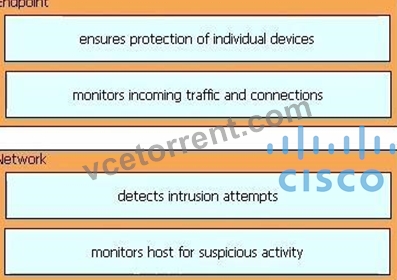
Drag and drop the uses on the left onto the type of security system on the right.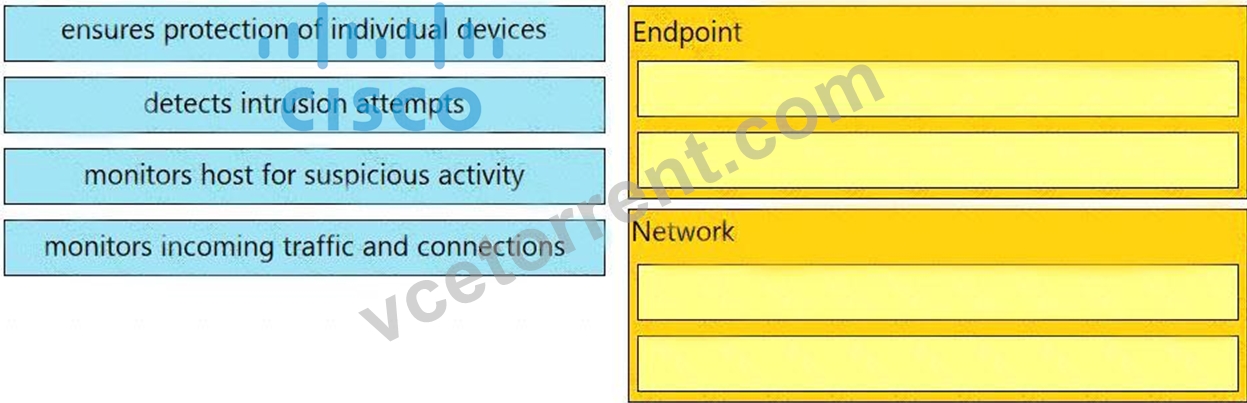
Answer:
Explanation: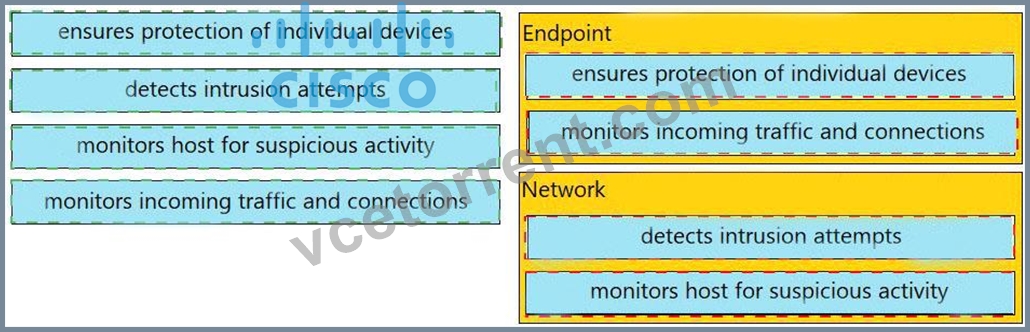
NEW QUESTION # 30
What is the practice of giving employees only those permissions necessary to perform their specific role within an organization?
- A. integrity validation
- B. due diligence
- C. need to know
- D. least privilege
Answer: D
Explanation:
Section: Security Concepts
NEW QUESTION # 31
Which two elements are used for profiling a network? (Choose two.)
- A. running processes
- B. OS fingerprint
- C. total throughput
- D. listening ports
- E. session duration
Answer: C,E
Explanation:
Explanation
A network profile should include some important elements, such as the following:
Total throughput - the amount of data passing from a given source to a given destination in a given period of time Session duration - the time between the establishment of a data flow and its termination Ports used - a list of TCP or UDP processes that are available to accept data Critical asset address space - the IP addresses or the logical location of essential systems or data Profiling data are data that system has gathered, these data helps for incident response and to detect incident Network profiling = throughput, sessions duration, port used, Critical Asset Address Space Host profiling = Listening ports, logged in accounts, running processes, running tasks,applications
NEW QUESTION # 32
Refer to the exhibit. A security analyst received a ticket about suspicious traffic from one of the workstations. During the investigation, the analyst discovered that the workstation was communicating with an external IP. The analyst could not investigate further and escalated the case to a T2 security analyst. What are the two data visibility challenges that the security analyst should identify? (Choose two.)
- A. A default user agent is present in the headers.
- B. HTTP requests and responses are sent in plaintext.
- C. Encrypted data is being transmitted.
- D. POST requests have a "Microsoft-IIS/7.5" server header.
- E. Traffic is not encrypted.
Answer: B,C
NEW QUESTION # 33
An engineer is working on a ticket for an incident from the incident management team A week ago. an external web application was targeted by a DDoS attack Server resources were exhausted and after two hours it crashed. An engineer was able to identify the attacker and technique used Three hours after the attack, the server was restored and the engineer recommended implementing mitigation by Blackhole filtering and transferred the incident ticket back to the IR team According to NIST SP800-61, at which phase of the incident response did the engineer finish work?
- A. preparation
- B. containment eradication and recovery
- C. post-incident activity
- D. detection and analysis
Answer: B
Explanation:
According to NIST SP800-61, the incident response phase called "Containment, Eradication, and Recovery" involves containing the incident, eradicating the threat, and recovering from the incident2. In the scenario described, the engineer worked on containing the DDoS attack by identifying the attacker and the technique used, which is part of the containment process. The recommendation to implement Blackhole filtering is part of the eradication process, where measures are taken to prevent the attack from happening again. Finally, restoring the server is part of the recovery process, where normal operations are resumed. Therefore, the engineer finished work during the "Containment, Eradication, and Recovery" phase. References: NIST SP800-
61 Computer Security Incident Handling Guide2.
NEW QUESTION # 34
Refer to the exhibit.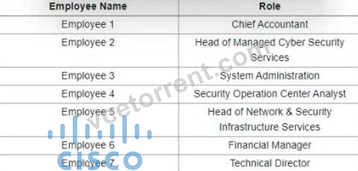
Which stakeholders must be involved when a company workstation is compromised?
- A. Employee 1 Employee 2, Employee 3, Employee 4, Employee 5, Employee 7
- B. Employee 1, Employee 2, Employee 4, Employee 5
- C. Employee 2, Employee 3, Employee 4, Employee 5
- D. Employee 4, Employee 6, Employee 7
Answer: D
Explanation:
When a company workstation is compromised, the stakeholders that must be involved are the ones who are responsible for the security incident response process. According to the table, these are Employee 4 (Security Operation Center Analyst), Employee 6 (Head of Network and Security Infrastructure Services), and Employee 7 (Technical Director). The other employees have different roles that are not directly related to the incident response process, such as accounting, financial management, or system administration. Reference := Understanding Cisco Cybersecurity Operations Fundamentals (CBROPS) v1.0, Module 1: Security Concepts, Lesson 1.4: Security Monitoring, Topic 1.4.1: Security Operations Center
NEW QUESTION # 35
What does the Zero Trust security model signify?
- A. Zero Trust addresses access control and states that an individual should have only the minimum access privileges necessary to perform specific tasks
- B. Zero Trust states that unless a subject is given explicit access to an object, it should be denied access to that object
- C. Zero Trust security means that no one is trusted by default from inside or outside the network
- D. Zero Trust states that no users should be given enough privileges to misuse the system on their own
Answer: C
NEW QUESTION # 36
What describes the vulnerability management process?
- A. securely observe and supervise devices that access sensitive enterprise data
- B. involves the deployment of hotfixes and patches that are released from time to time
- C. systems engineering process for establishing and preserving consistency of a product's performance
- D. cyclical approach of identifying classifying and mitigating software vulnerabilities
Answer: D
NEW QUESTION # 37
What is a scareware attack?
- A. using the spoofed email addresses to trick people into providing login credentials
- B. inserting malicious code that causes popup windows with flashing colors
- C. overwhelming a targeted website with fake traffic
- D. gaming access to your computer and encrypting data stored on it
Answer: B
Explanation:
Scareware is a type of malware attack that tricks users into believing their computer is infected with a virus, prompting them to download and pay for fake antivirus software. The attack often uses popup windows with flashing colors (D) to create a sense of urgency and scare the user into taking immediate action.
Cisco Certified CyberOps Associate certification materials
NEW QUESTION # 38
Refer to the exhibit.
What does the message indicate?
- A. a successful access attempt was made to retrieve the password file
- B. a denied access attempt was made to retrieve the password file
- C. a successful access attempt was made to retrieve the root of the website
- D. an access attempt was made from the Mosaic web browser
Answer: C
NEW QUESTION # 39
An engineer received an alert affecting the degraded performance of a critical server Analysis showed a heavy CPU and memory load. What is the next step the engineer should take to investigate this resource usage?
- A. Run "ps -m" to capture the existing state of daemons and map the required processes to find the gap
- B. Run "ps -d" to decrease the priority state of high-load processes to avoid resource exhaustion
- C. Run "ps -ef to understand which processes are taking a high amount of resources
- D. Run "ps -u" to find out who executed additional processes that caused a high load on a server
Answer: C
Explanation:
When a server is experiencing heavy CPU and memory load, the initial step is to identify the processes consuming the most resources. The command "ps -ef" provides a detailed view of all running processes, including their IDs, CPU, and memory usage, which helps in pinpointing the resource-intensive processes1234. References: This approach is supported by various resources on server management and troubleshooting, which recommend using the "ps -ef" command as a starting point for investigating high resource usage on servers
NEW QUESTION # 40 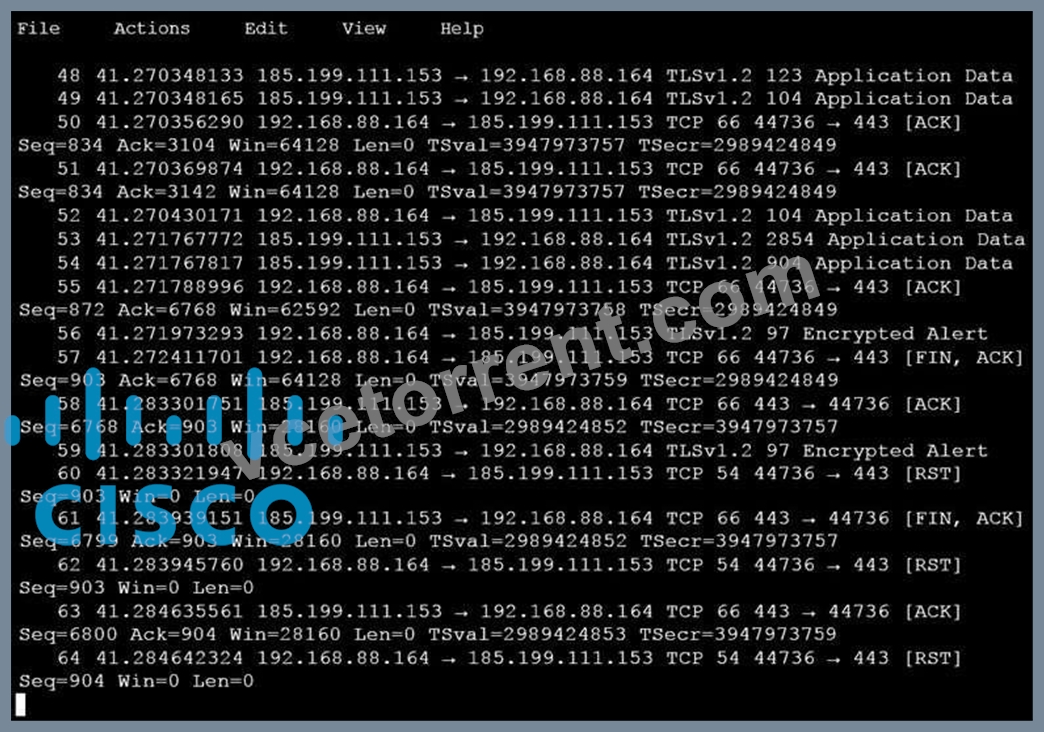
An analyst is investigating a host in the network that appears to be communicating to a command and control server on the Internet. After collecting this packet capture the analyst cannot determine the technique and payload used for the communication.
Which obfuscation technique is the attacker using?
- A. Base64 encoding
- B. transport layer security encryption
- C. ROT13 encryption
- D. SHA-256 hashing
Answer: B
NEW QUESTION # 41
Which type of attack involves sending input commands to a web server to access data?
- A. Denial of service
- B. Cross-site scripting
- C. DNS poisoning
- D. SQL injection
Answer: D
NEW QUESTION # 42
......
REAL 200-201 Exam Questions With 100% Refund Guarantee : https://examcollection.vcetorrent.com/200-201-valid-vce-torrent.html