

AZ-500 Practice Test Questions Updated 497 Questions
Microsoft AZ-500 Dumps - Secret To Pass in First Attempt
NEW QUESTION # 280
You have an Azure Active Directory (Azure AD) tenant.
You have the deleted objects shown in the following table.
On May 4, 2020, you attempt to restore the deleted objects by using the Azure Active Directory admin center.
Which two objects can you restore? Each correct answer presents a complete solution.
NOTE: Each correct selection is worth one point.
- A. Group1
- B. User1
- C. Group2
- D. User2
Answer: C,D
Explanation:
Deleted users and deleted Office 365 groups are available for restore for 30 days.
You cannot restore a deleted security group.
Reference:
https://docs.microsoft.com/en-us/azure/active-directory/users-groups-roles/groups-restore-deleted
NEW QUESTION # 281
You have an Azure subscription that contains the virtual machines shown in the following table.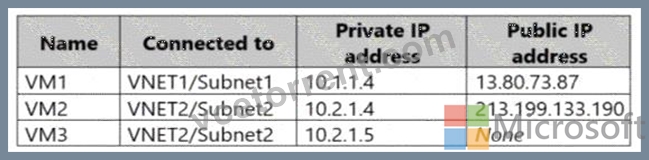
Subnet1 and Subnet2 have a Microsoft.Storage service endpoint configured.
You have an Azure Storage account named storageacc1 that is configured as shown in the following exhibit.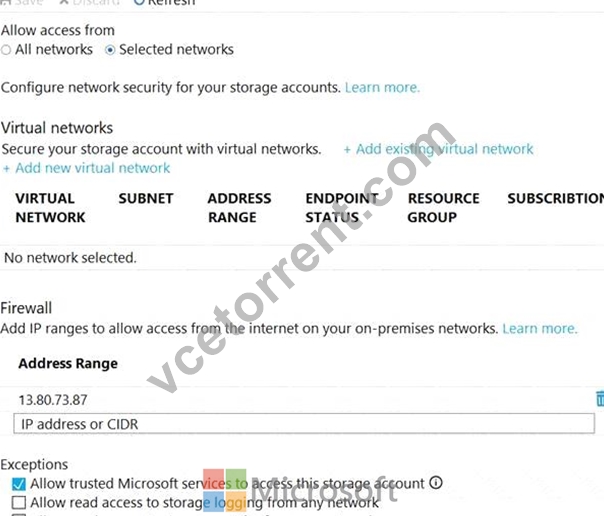
For each of the following statements, select Yes if the statement is true. Otherwise, select No.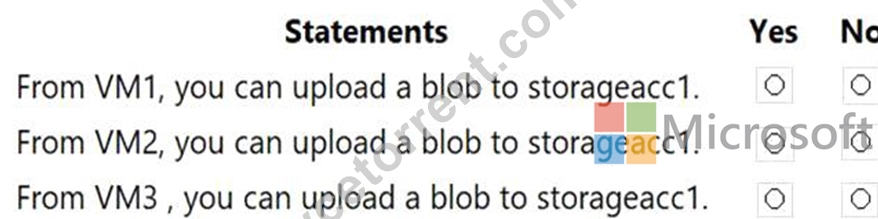
Answer:
Explanation: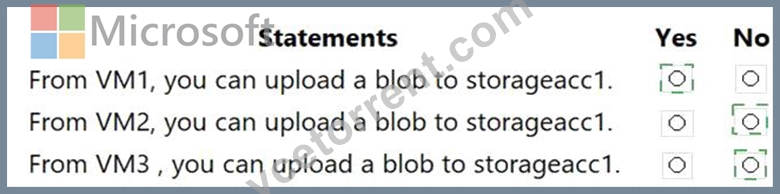
Explanation: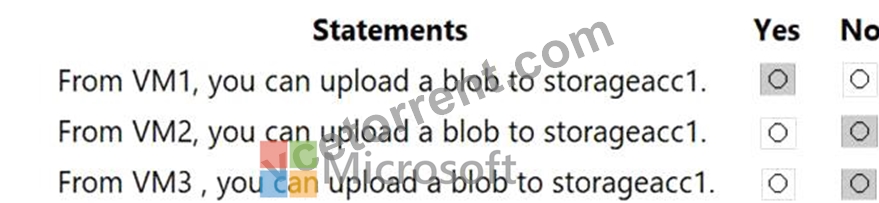
Box 1: Yes
The public IP of VM1 is allowed through the firewall.
Box 2: No
The allowed virtual network list is empty so VM2 cannot access storageacc1 directly. The public IP address of VM2 is not in the allowed IP list so VM2 cannot access storageacc1 over the Internet.
Box 3: No
The allowed virtual network list is empty so VM3 cannot access storageacc1 directly. VM3 does not have a public IP address so it cannot access storageacc1 over the Internet.
Reference:
https://docs.microsoft.com/en-gb/azure/storage/common/storage-network-security
NEW QUESTION # 282
You need to configure network connectivity between a virtual network named VNET1 and a virtual network named VNET2. The solution must ensure that virtual machines connected to VNET1 can communicate with virtual machines connected to VNET2.
To complete this task, sign in to the Azure portal and modify the Azure resources.
Answer:
Explanation:
See the explanation below.
Explanation
You need to configure VNet Peering between the two networks. The questions states, "The solution must ensure that virtual machines connected to VNET1 can communicate with virtual machines connected to VNET2". It doesn't say the VMs on VNET2 should be able to communicate with VMs on VNET1. Therefore, we need to configure the peering to allow just the one-way communication.
1. In the Azure portal, type Virtual Networks Virtual Networks from the search results then select VNET1. Alternatively, browse to in the left navigation pane.
2. In the properties of VNET1, click on
3. In the Peerings blade, click Add
4. In the Name of the peering from VNET1 to remote virtual network box, enter a name such as VNET1-VNET2 (this is the name that the peering will be displayed as in VNET1)
5. In the Virtual Network box, select
6. In the Name of the peering from remote virtual network to VNET1 box, enter a name such as VNET2-VNET1 (this is the name that the peering will be displayed as in VNET2).
There is an option Allow virtual network access from VNET to remote virtual network. This should be left as Enabled.
7. For the option Allow virtual network access from remote network to VNET1, click the slider button to Disabled.
8. Click the OK button to save the changes.
Reference:
https://docs.microsoft.com/en-us/azure/virtual-network/virtual-network-manage-peering
NEW QUESTION # 283
You have an Azure subscription that contains the resources shown in the following Table.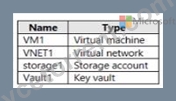
You plan to enable Microsoft Defender for Cloud for the subscription. Which resources can be protected by using Microsoft Defender for Cloud?
- A. VM1, VNET1, and storage1 only
- B. VM1, storage1, and Vault1 only
- C. VM1.VNET1, storage1, and Vault1
- D. VM1 and storage1 only
- E. VM1 and VNET only
Answer: C
NEW QUESTION # 284
You have the Azure key vaults shown in the following table.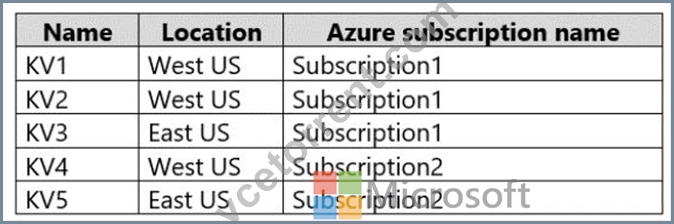
KV1 stores a secret named Secret1 and a key for a managed storage account named Key1.
You back up Secret1 and Key1.
To which key vaults can you restore each backup? To answer, select the appropriate options in the answer area.
NOTE: Each correct selection is worth one point.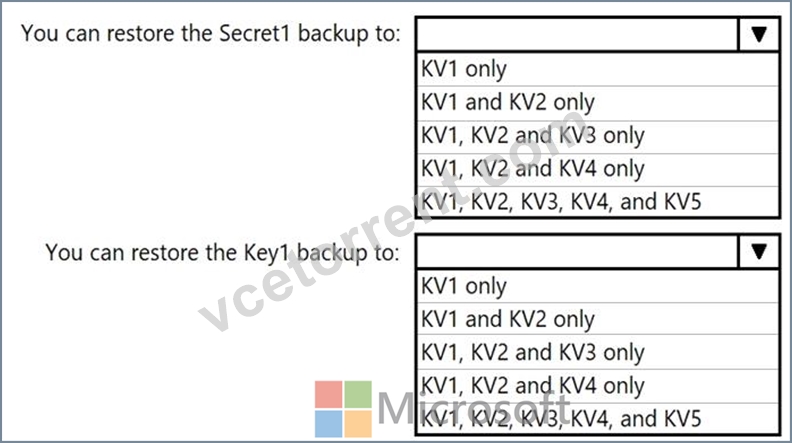
Answer:
Explanation: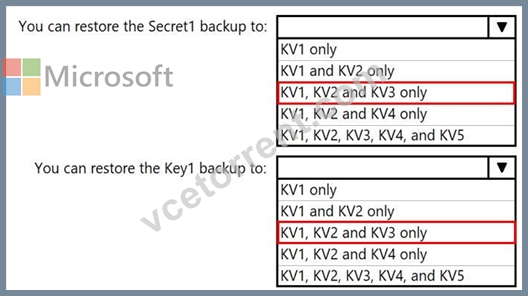
Explanation:
The backups can only be restored to key vaults in the same subscription and same geography. You can restore to a different region in the same geography.
NEW QUESTION # 285
You have an Azure subscription that contains the resources shown in the following table.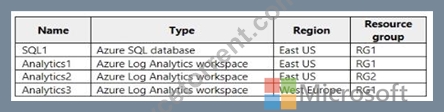
You create the Azure Storage accounts shown in the following table.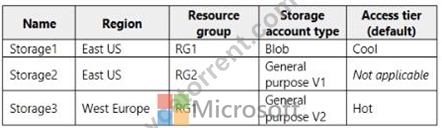
You need to configure auditing for SQL1.
Which storage accounts and Log Analytics workspaces can you use as the audit log destination? To answer, select the appropriate options in the answer area.
NOTE: Each correct selection is worth one point.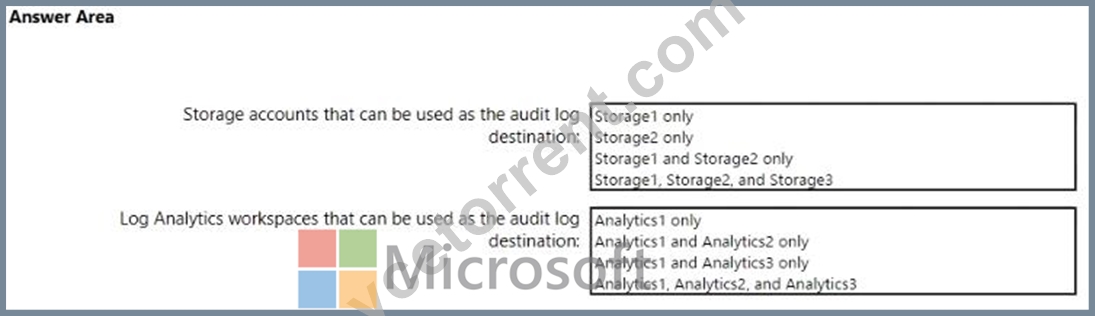
Answer:
Explanation: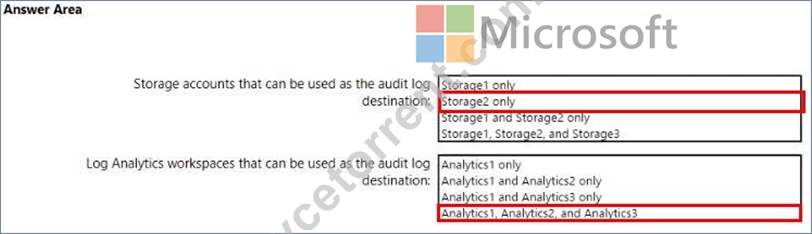
NEW QUESTION # 286
You have an Azure subscription named Sub1 that is associated to an Azure Active Directory (Azure AD) tenant named contoso.com.
You plan to implement an application that will consist of the resources shown in the following table.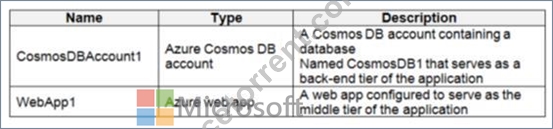
Users will authenticate by using their Azure AD user account and access the Cosmos DB account by using resource tokens.
You need to identify which tasks will be implemented in CosmosDB1 and WebApp1.
Which task should you identify for each resource? To answer, select the appropriate options in the answer area.
NOTE: Each correct selection is worth one point.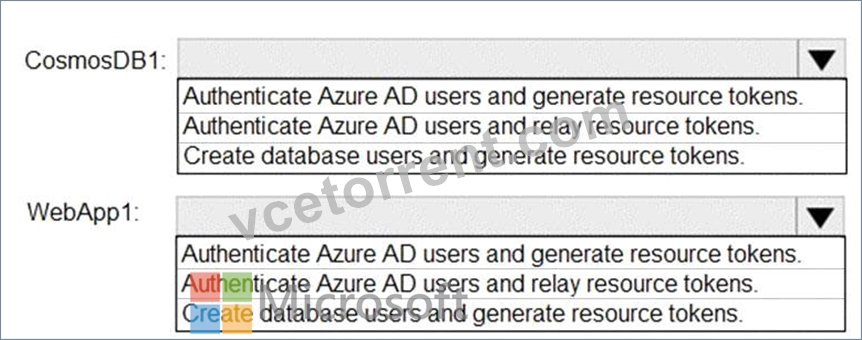
Answer:
Explanation: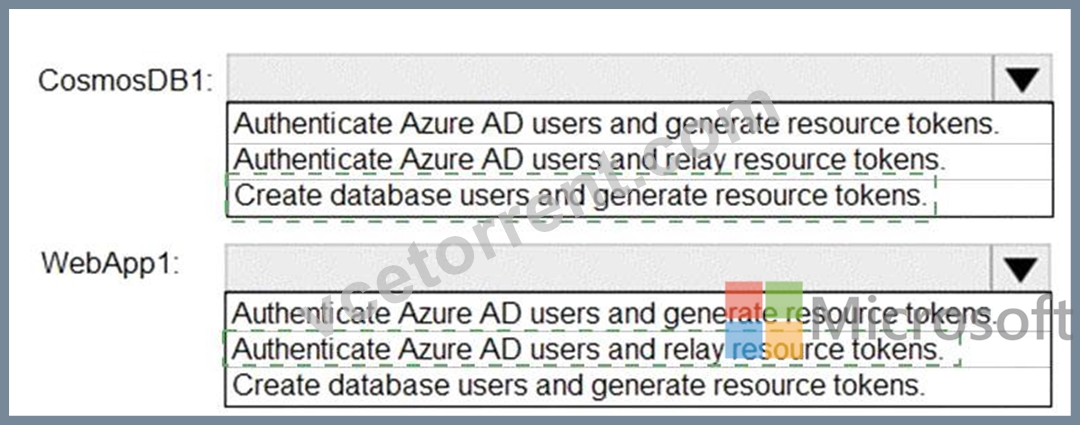
Explanation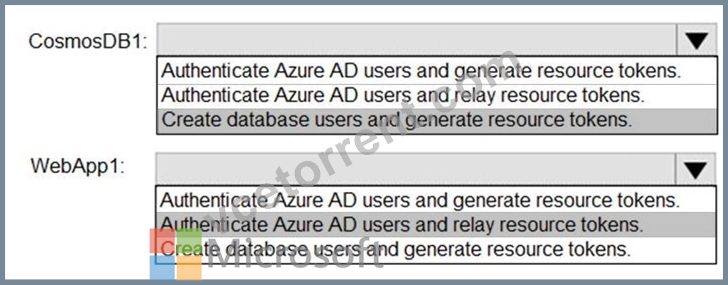
CosmosDB1: Create database users and generate resource tokens.
Azure Cosmos DB resource tokens provide a safe mechanism for allowing clients to read, write, and delete specific resources in an Azure Cosmos DB account according to the granted permissions.
WebApp1: Authenticate Azure AD users and relay resource tokens
A typical approach to requesting, generating, and delivering resource tokens to a mobile application is to use a resource token broker. The following diagram shows a high-level overview of how the sample application uses a resource token broker to manage access to the document database data: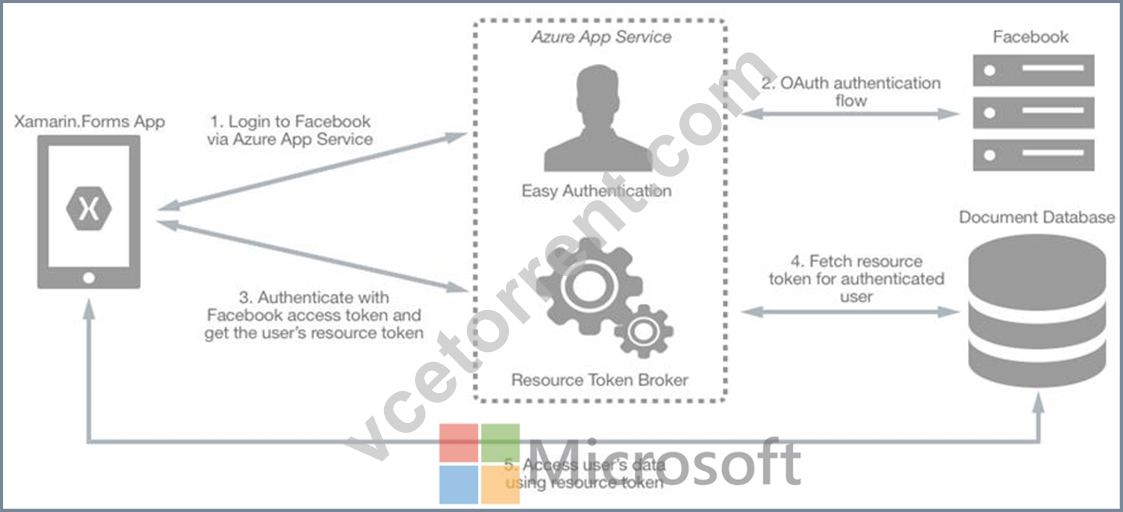
References:
https://docs.microsoft.com/en-us/xamarin/xamarin-forms/data-cloud/cosmosdb/authentication
NEW QUESTION # 287
You have an Azure Active Directory (Azure AD) tenant named contoso.com that contains the users shown in the following table.
You create and enforce an Azure AD Identity Protection user risk policy that has the following settings:
* Assignment: Include Group1, Exclude Group2
* Conditions: Sign-in risk of Medium and above
* Access: Allow access, Require password change
For each of the following statements, select Yes if the statement is true. Otherwise, select No.
NOTE: Each correct selection is worth one point.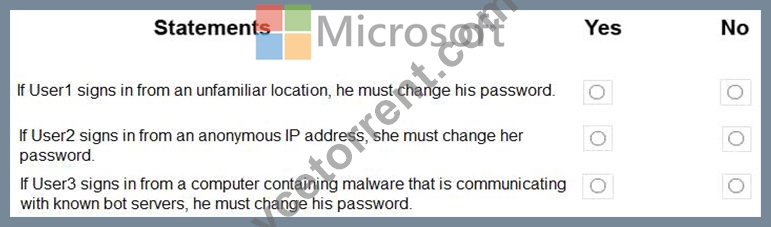
Answer:
Explanation: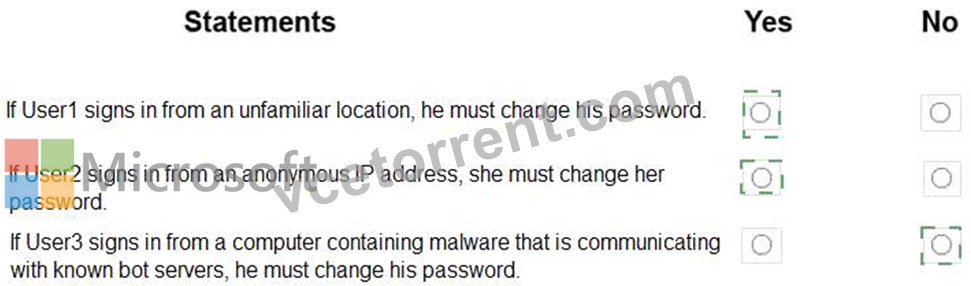
Explanation: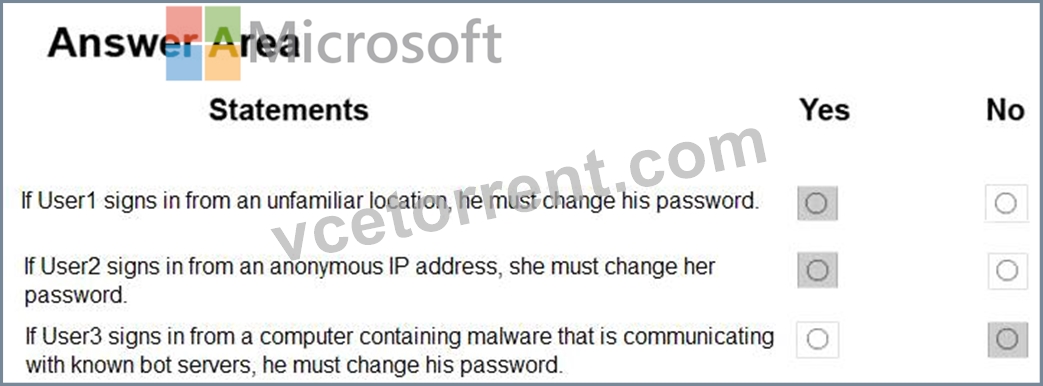
Box 1: Yes
User1 is member of Group1. Sign in from unfamiliar location is risk level Medium.
Box 2: Yes
User2 is member of Group1. Sign in from anonymous IP address is risk level Medium.
Box 3: No
Sign-ins from IP addresses with suspicious activity is low.
Note: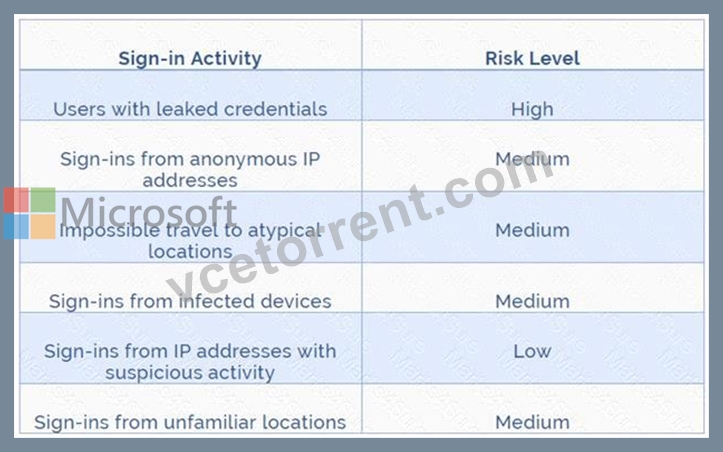
Azure AD Identity protection can detect six types of suspicious sign-in activities:
* Users with leaked credentials
* Sign-ins from anonymous IP addresses
* Impossible travel to atypical locations
* Sign-ins from infected devices
* Sign-ins from IP addresses with suspicious activity
* Sign-ins from unfamiliar locations
These six types of events are categorized in to 3 levels of risks - High, Medium & Low:
References:
http://www.rebeladmin.com/2018/09/step-step-guide-configure-risk-based-azure-conditional-access-policies/
NEW QUESTION # 288
You create an alert rule that has the following settings:
* Resource: RG1
* Condition: All Administrative operations
* Actions: Action groups configured for this alert rule: ActionGroup1
* Alert rule name: Alert1
You create an action rule that has the following settings:
* Scope: VM1
* Filter criteria: Resource Type = "Virtual Machines"
* Define on this scope: Suppression
* Suppression config: From now (always)
* Name: ActionRule1
For each of the following statements, select Yes if the statement is true. Otherwise, select No.
Note: Each correct selection is worth one point.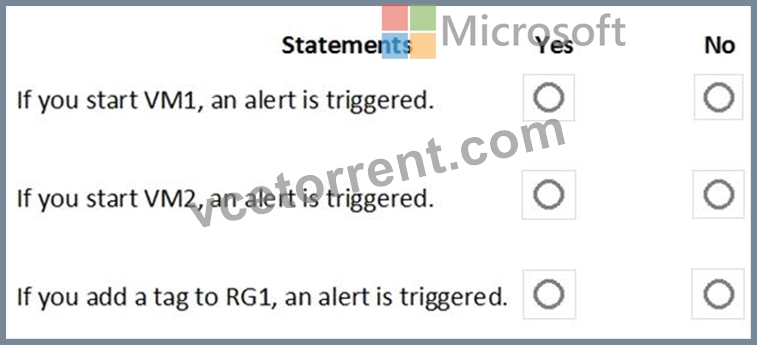
Answer:
Explanation: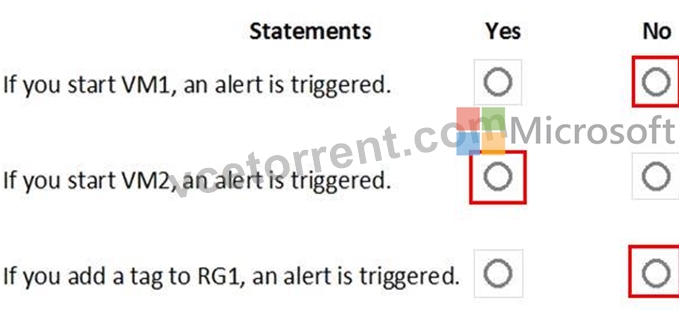
Explanation:
Box 1:
The scope for the action rule is set to VM1 and is set to suppress alerts indefinitely.
Box 2:
The scope for the action rule is not set to VM2.
Box 3:
Adding a tag is not an administrative operation.
References:
https://docs.microsoft.com/en-us/azure/azure-monitor/platform/alerts-activity-log
https://docs.microsoft.com/en-us/azure/azure-monitor/platform/alerts-action-rules
NEW QUESTION # 289
Which virtual networks in Sub1 can User2 modify and delete in their current state? To answer, select the appropriate options in the answer area.
NOTE: Each correct selection is worth one point.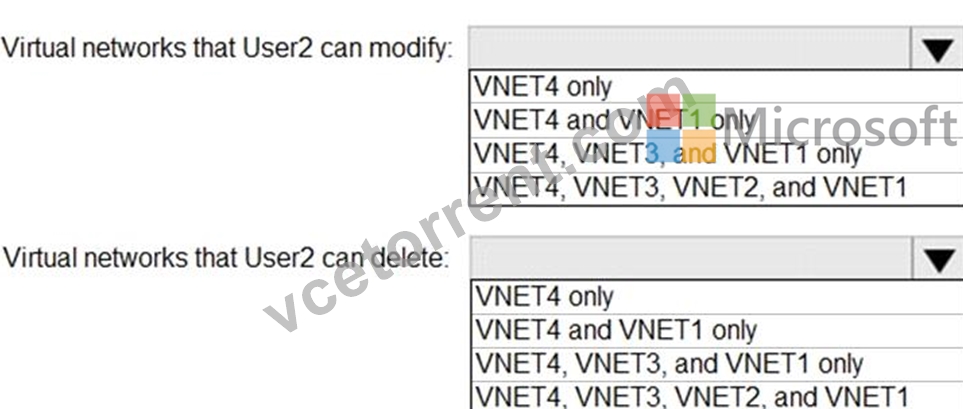
Answer:
Explanation: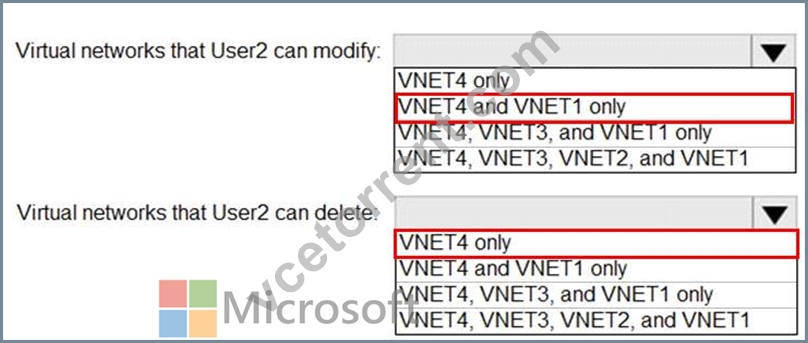
Reference:
https://docs.microsoft.com/en-us/azure/azure-resource-manager/resource-group-lock-resources
NEW QUESTION # 290
You have the Azure virtual machines shown in the following table.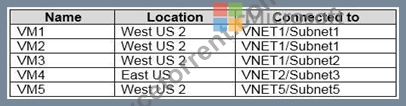
Each virtual machine has a single network interface.
You add the network interface of VM1 to an application security group named ASG1.
You need to identify the network interfaces of which virtual machines you can add to ASG1.
What should you identify?
- A. VM2 only
- B. VM2 and VM3 only
https://www.fast2test.com/AZ-500-practice-test.html 24
Valid Fast2test AZ-500 Exam PDF Dumps - New AZ-500 Real Exam Questions - C. VM2, VM3, VM4, and VM5
- D. VM2, VM3, and VM5 only
Answer: B
Explanation:
Explanation/Reference:
https://docs.microsoft.com/en-us/azure/virtual-network/application-security-groups
NEW QUESTION # 291
You have an Azure subscription that contains the virtual machines shown in the following table.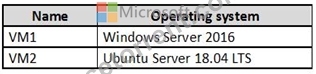
From Azure Security Center, you turn on Auto Provisioning.
You deploy the virtual machines shown in the following table.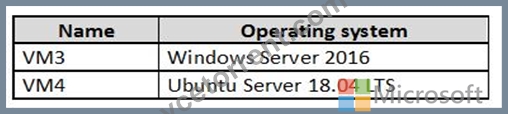
On which virtual machines is the Log Analytics agent installed?
- A. VM3 only
- B. VM1 and VM3 only
- C. VM3 and VM4 only
- D. VM1, VM2, VM3, and VM4
Answer: D
Explanation:
When automatic provisioning is On, Security Center provisions the Log Analytics Agent on all supported Azure VMs and any new ones that are created.
Supported Operating systems include: Ubuntu 14.04 LTS (x86/x64), 16.04 LTS (x86/x64), and 18.04 LTS (x64) and Windows Server 2008 R2, 2012, 2012 R2, 2016, version 1709 and 1803
Reference:
https://docs.microsoft.com/en-us/azure/security-center/security-center-enable-data-collection
NEW QUESTION # 292
You are evaluating the security of the network communication between the virtual machines in Sub2.
For each of the following statements, select Yes if the statement is true. Otherwise, select No.
NOTE: Each correct selection is worth one point.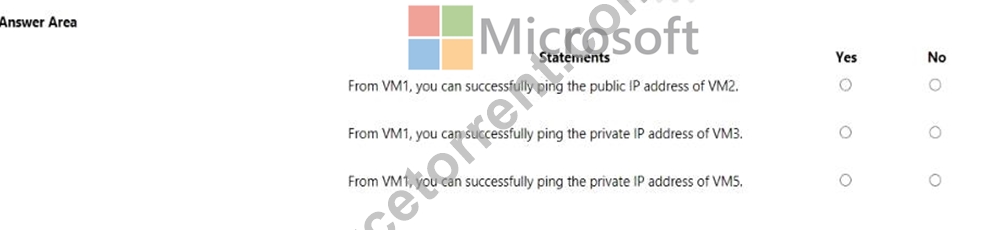
Answer:
Explanation: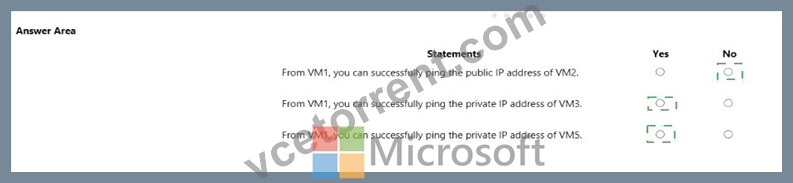
Explanation:
Q1: No { and it should not be allowed as only TCP 80 is allowed from the "Internet" service tag Q2: Yes {as it should be for VMs in the same local subnet pinging each other on private IP and no NSG configured} Q3: Yes {VM5 is in subnet where 1st rule of NSG allows any traffic from any source to the destination}
NEW QUESTION # 293
You are testing an Azure Kubernetes Service (AKS) cluster. The cluster is configured as shown in the exhibit. (Click the Exhibit tab.)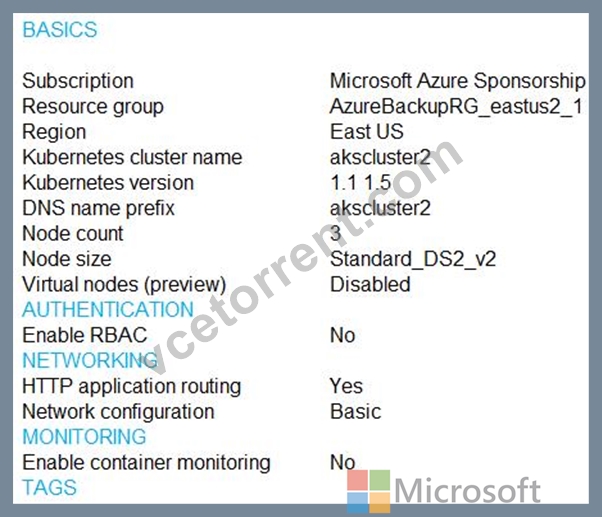
You plan to deploy the cluster to production. You disable HTTP application routing.
You need to implement application routing that will provide reverse proxy and TLS termination for AKS services by using a single IP address.
What should you do?
- A. Create an AKS Ingress controller.
- B. Install the container network interface (CNI) plug-in.
- C. Create an Azure Standard Load Balancer.
- D. Create an Azure Basic Load Balancer.
Answer: A
Explanation:
An ingress controller is a piece of software that provides reverse proxy, configurable traffic routing, and TLS termination for Kubernetes services.
Reference:
https://docs.microsoft.com/en-us/azure/aks/ingress-tls
NEW QUESTION # 294
You create resources in an Azure subscription as shown in the following table.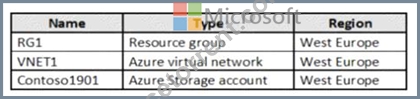
VNET1 contains two subnets named Subnet1 and Subnet2. Subnet1 has a network ID of 10.0.0.0/24. Subnet2 has a network ID of 10.1.1.0/24.
Contoso1901 is configured as shown in the exhibit. (Click the Exhibit tab.)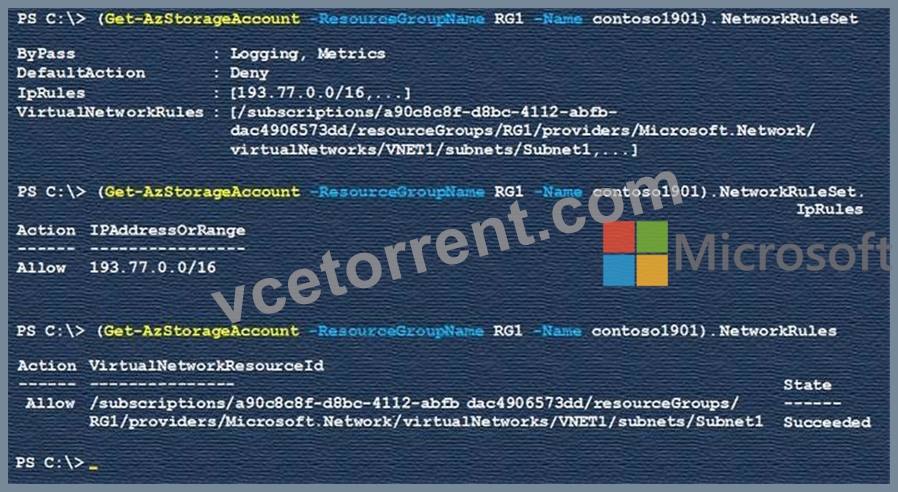
For each of the following statements, select Yes if the statement is true. Otherwise, select No.
NOTE: Each correct selection is worth one point.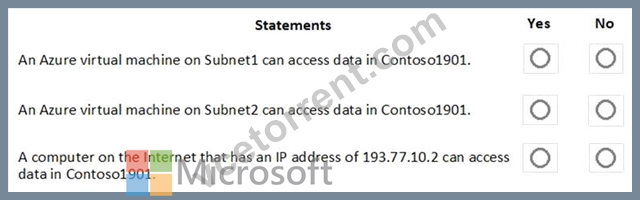
Answer:
Explanation: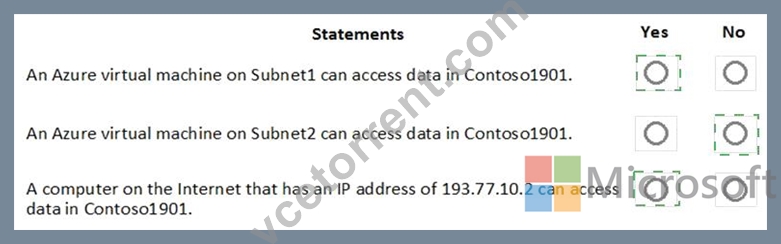
Explanation: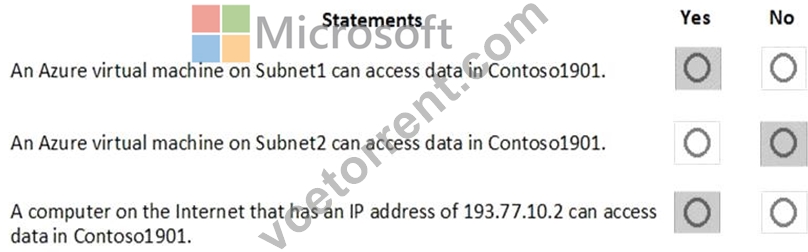
Box 1: Yes
Access from Subnet1 is allowed.
Box 2: No
No access from Subnet2 is allowed.
Box 3: Yes
Access from IP address 193.77.10.2 is allowed.
NEW QUESTION # 295
HOTSPOT
You have an Azure Active Directory (Azure AD) tenant named contoso.com that contains the users shown in the following table.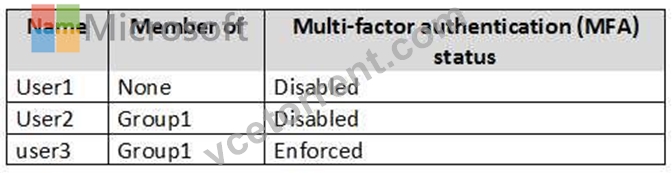
Azure AD Privileged Identity Management (PIM) is enabled for the tenant.
In PIM, the Password Administrator role has the following settings:
Maximum activation duration (hours): 2
Send email notifying admins of activation: Disable
Require incident/request ticket number during activation: Disable
Require Azure Multi-Factor Authentication for activation: Enable
Require approval to activate this role: Enable
Selected approver: Group1
You assign users the Password Administrator role as shown in the following table.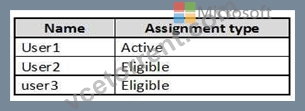
For each of the following statements, select Yes if the statement is true. Otherwise, select No.
NOTE: Each correct selection is worth one point.
Hot Area: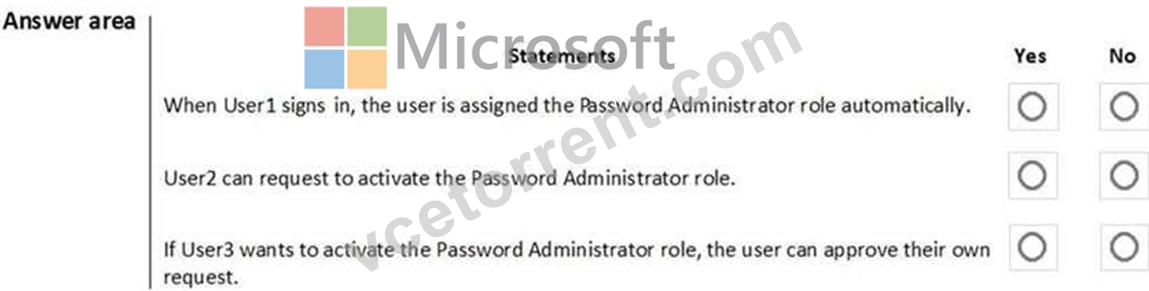
Answer:
Explanation: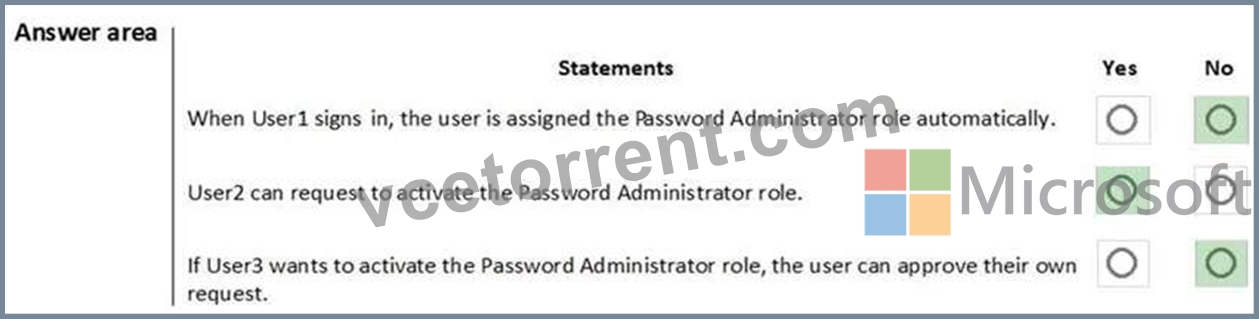
Explanation:
Box 1: Yes
Active assignments don't require the member to perform any action to use the role. Members assigned as active have the privileges assigned to the role at all times.
Box 2: No
MFA is disabled for User2 and the setting Require Azure Multi-Factor Authentication for activation is enabled.
Note: Eligible assignments require the member of the role to perform an action to use the role. Actions might include performing a multi-factor authentication (MFA) check, providing a business justification, or requesting approval from designated approvers.
Box 3: Yes
User3 is Group1, which is a Selected Approver Group
Reference:
https://docs.microsoft.com/bs-latn-ba/azure/active-directory/privileged-identity-management/pim-resource- roles-assign-roles
NEW QUESTION # 296
You have 20 Azure subscriptions and a security group named Group1. The subscriptions are children of the root management group.
Each subscription contains a resource group named RG1.
You need to ensure that for each subscription RG1 meets the following requirements:
The members of Group1 are assigned the Owner role.
The modification of permissions to RG1 is prevented.
What should you do? To answer, select the appropriate options in the answer area.
NOTE: Each correct selection is worth one point.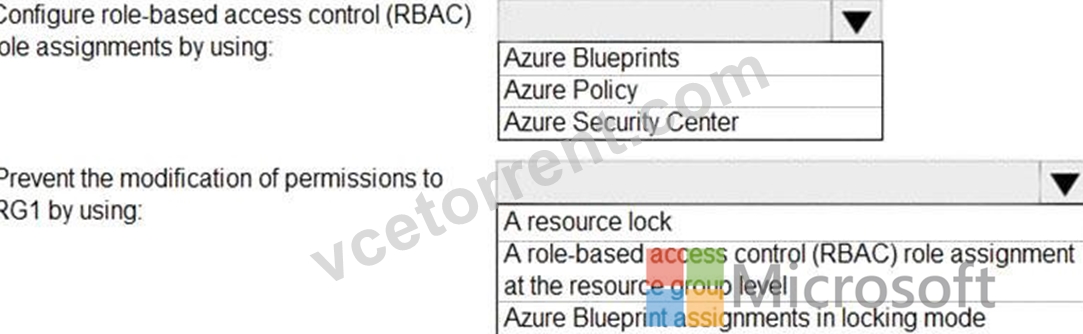
Answer:
Explanation: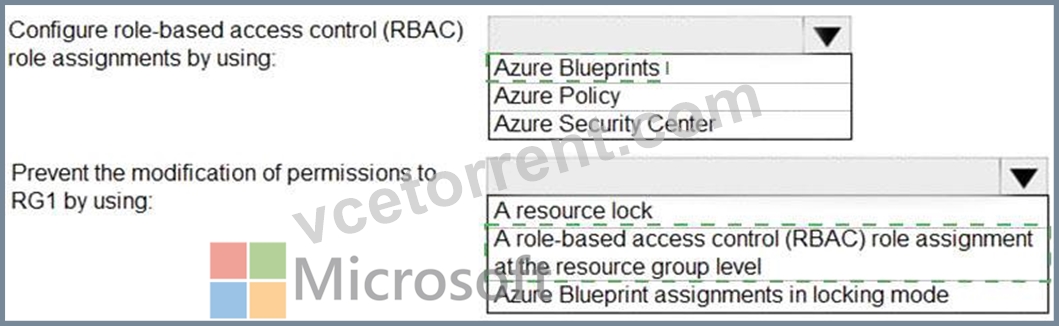
Explanation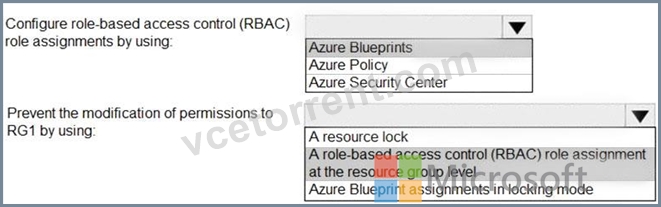
NEW QUESTION # 297
You suspect that users are attempting to sign in to resources to which they have no access.
You need to create an Azure Log Analytics query to identify failed user sign-in attempts from the last three days. The results must only show users who had more than five failed sign-in attempts.
How should you configure the query? To answer, select the appropriate options in the answer area.
NOTE: Each correct selection is worth one point.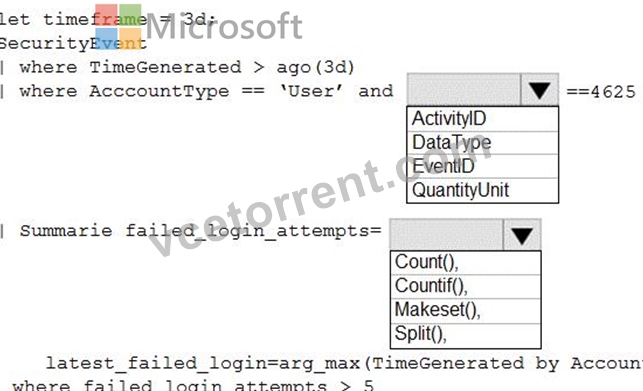
Answer:
Explanation: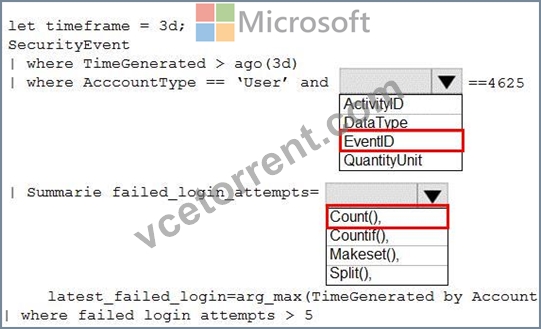
Reference:
https://docs.microsoft.com/en-us/azure/azure-monitor/log-query/examples
NEW QUESTION # 298
You have an Azure subscription named Subscription1 that contains the resources shown in the following table.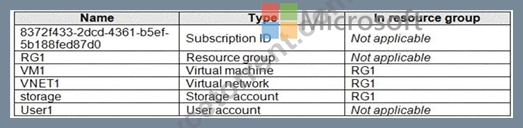
You create an Azure role by using the following JSON file.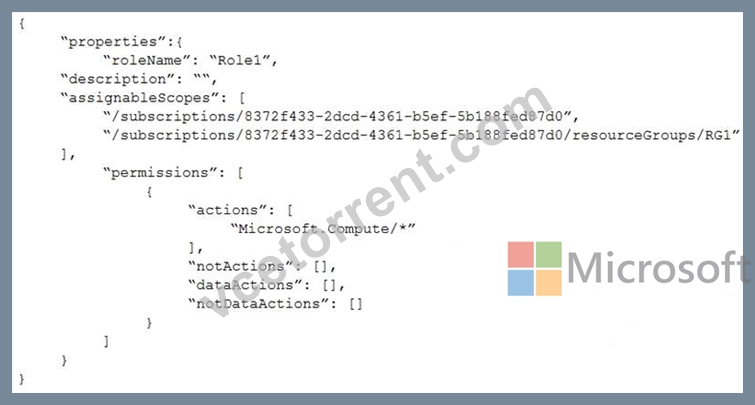
You assign Role1 to User1 for RG1.
For each of the following statements, select Yes if the statement is true. Otherwise, select No.
NOTE: Each correct selection is worth one point.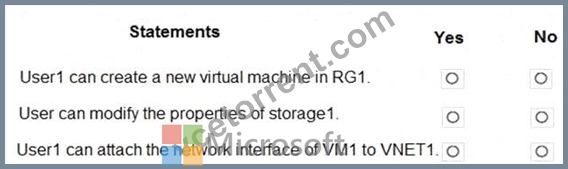
Answer:
Explanation: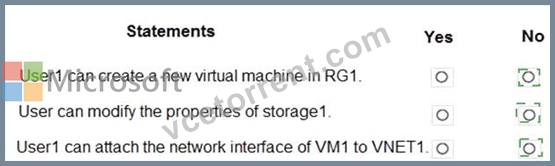
Explanation:
NO
NO
NO
Reference:
https://docs.microsoft.com/en-us/azure/role-based-access-control/built-in-roles#compute
NEW QUESTION # 299
You are evaluating the security of the network communication between the virtual machines in Sub2.
For each of the following statements, select Yes if the statement is true. Otherwise, select No.
NOTE: Each correct selection is worth one point.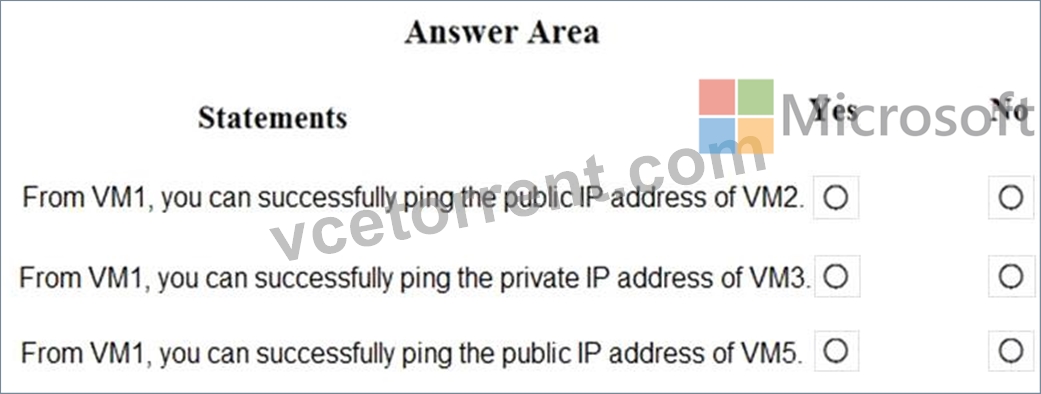
Answer:
Explanation: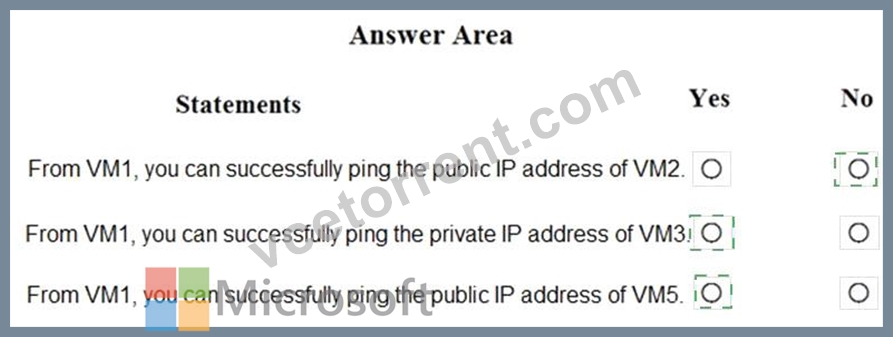
Explanation
Yes,
Yes
No
NEW QUESTION # 300
You have an Azure subscription named Subscription1 that contains a resource group named RG1 and a user named User1. User1 is assigned the Owner role for RG1.
You create an Azure Blueprints definition named Blueprint1 that includes a resource group named RG2 as shown in the following exhibit.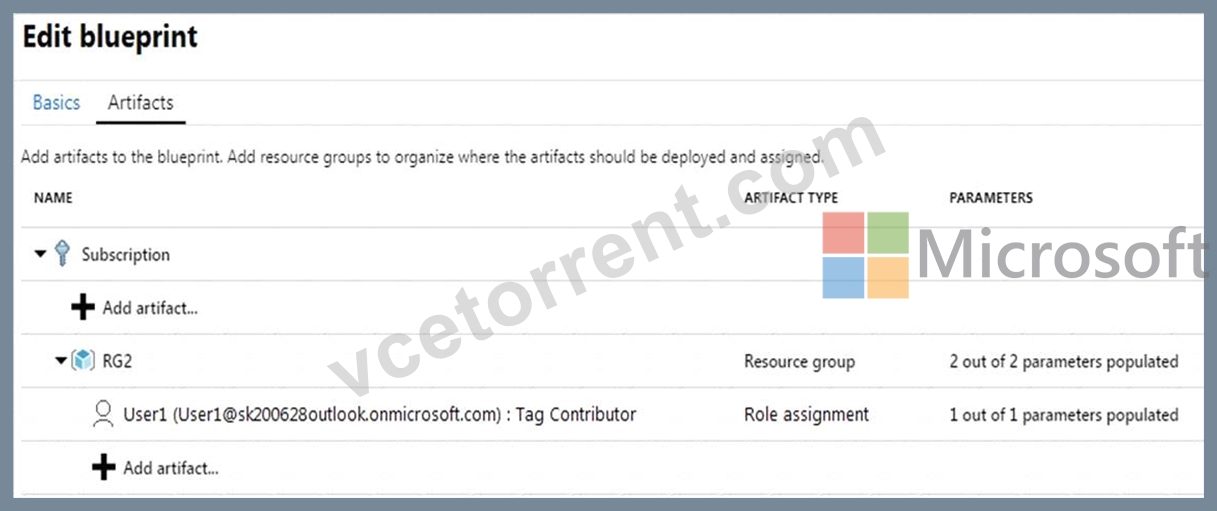
You assign Blueprint1 to Subscription1 by using the following settings:
* Lock assignment: Read Only
* Managed Identity: System assigned
For each of the following statements, select Yes if the statement is true. Otherwise, select No.
NOTE: Each correct selection is worth one point.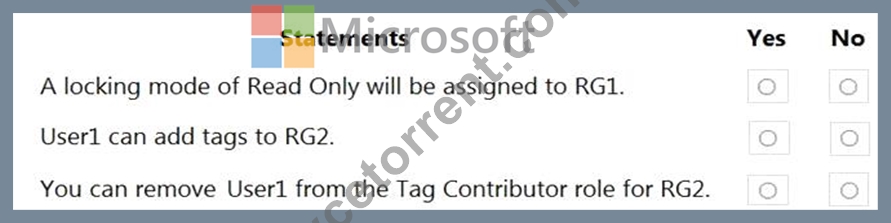
Answer:
Explanation: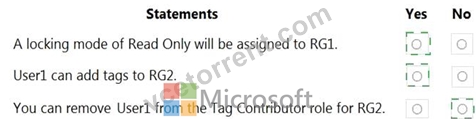
Explanation:
Graphical user interface, text, application Description automatically generated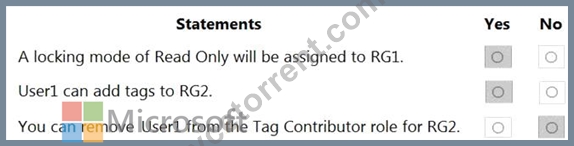
Reference:
https://docs.microsoft.com/en-us/azure/governance/blueprints/concepts/resource-locking
NEW QUESTION # 301
You have an Azure Active Directory (Azure AD) tenant named contoso.com that contains three security groups named Group1, Group2, and Group3 and the users shown in the following table.
Group3 is a member of Group2.
In contoso.com, you register an enterprise application named App1 that has the following settings:
* Owners: User1
* Users and groups: Group2
You configure the properties of App1 as shown in the following exhibit.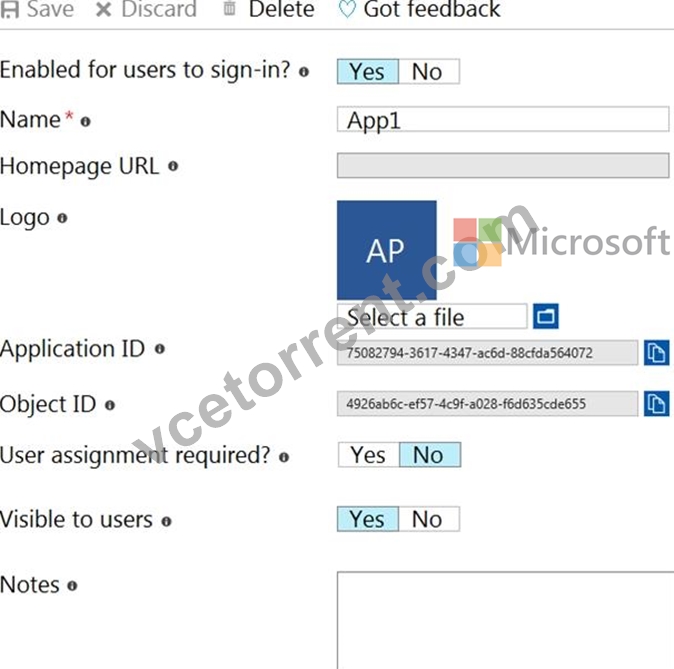
For each of the following statements, select Yes if the statement is true. Otherwise, select no.
NOTE: Each correct selection is worth one point.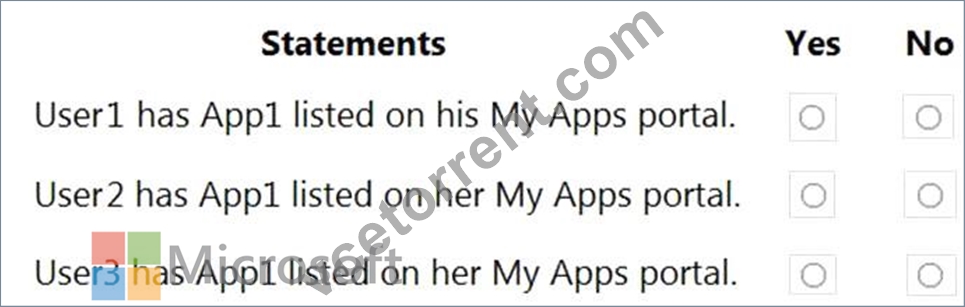
Answer:
Explanation: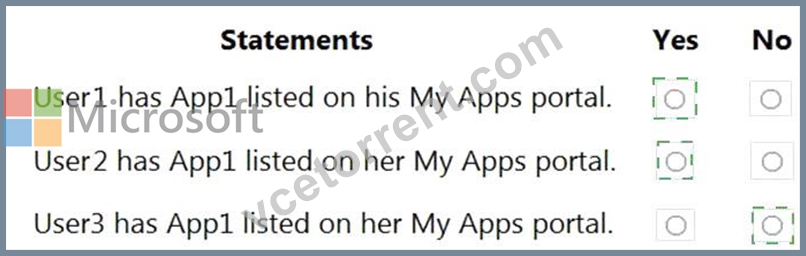
Explanation:
Text Description automatically generated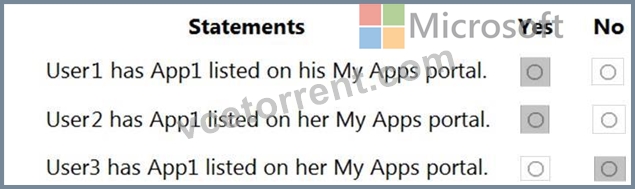
Reference:
https://docs.microsoft.com/en-us/azure/active-directory/manage-apps/assign-user-or-group-access-portal
NEW QUESTION # 302
You have the Azure key vaults shown in the following table.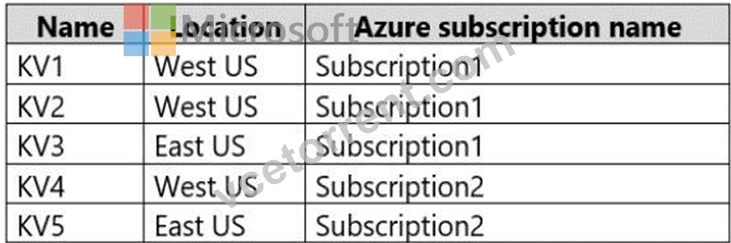
KV1 stores a secret named Secret1 and a key for a managed storage account named Key1.
You back up Secret1 and Key1.
To which key vaults can you restore each backup? To answer, select the appropriate options in the answer area.
NOTE: Each correct selection is worth one point.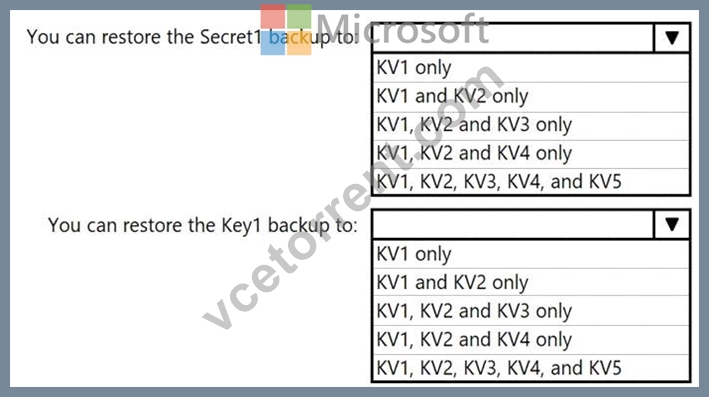
Answer:
Explanation: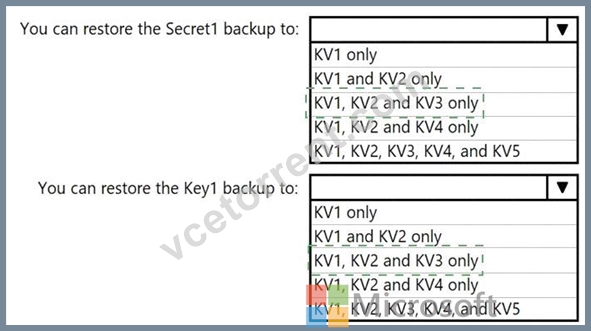
Explanation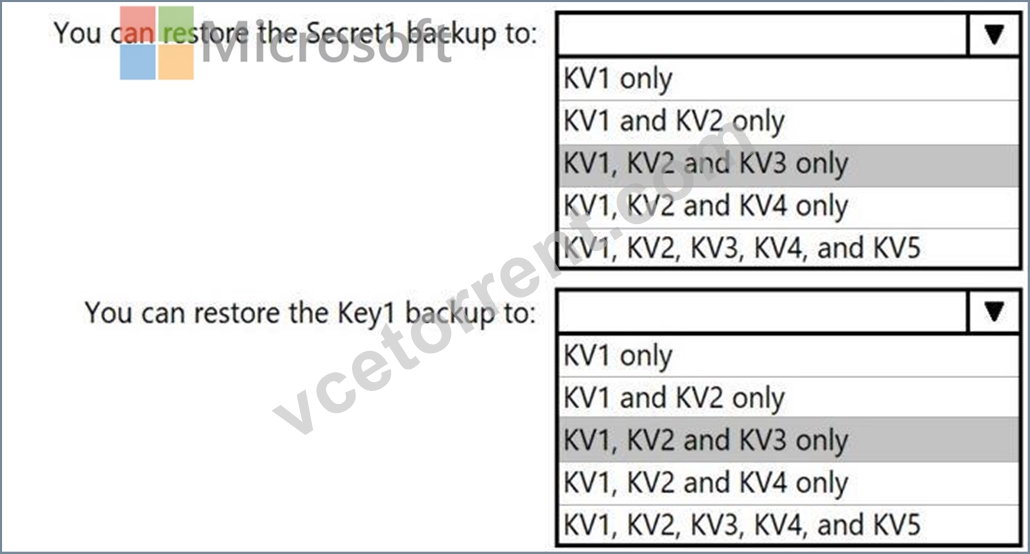
The backups can only be restored to key vaults in the same subscription and same geography. You can restore to a different region in the same geography.
https://docs.microsoft.com/en-us/azure/key-vault/general/backup?tabs=azure-cli
NEW QUESTION # 303
Your company has two offices in Seattle and New York. Each office connects to the Internet by using a NAT device. The offices use the IP addresses shown in the following table.
The company has an Azure Active Directory (Azure AD) tenant named contoso.com. The tenant contains the users shown in the following table.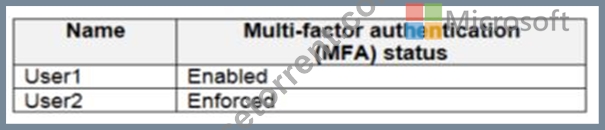
The MFA service settings are configured as shown in the exhibit. (Click the Exhibit tab.)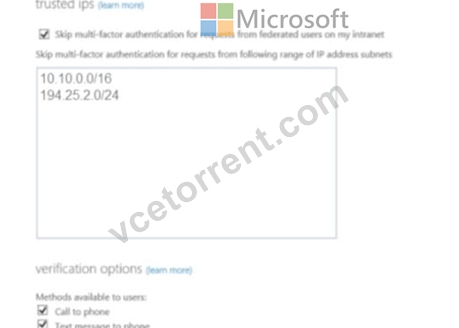
For each of the following statements, select Yes if the statement is true. Otherwise, select No.
NOTE: Each correct selection is worth one point.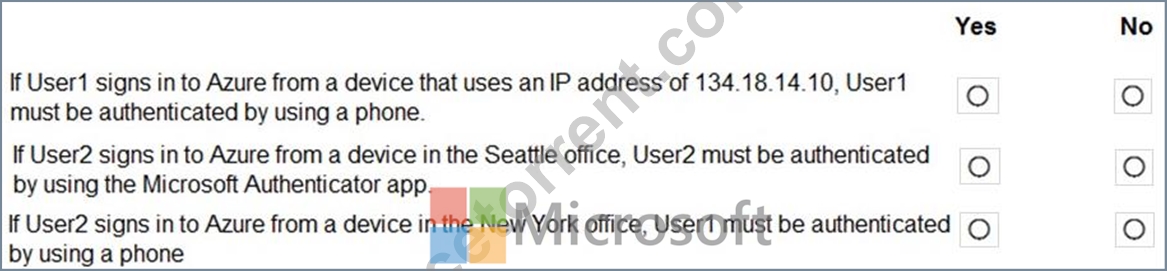
Answer:
Explanation: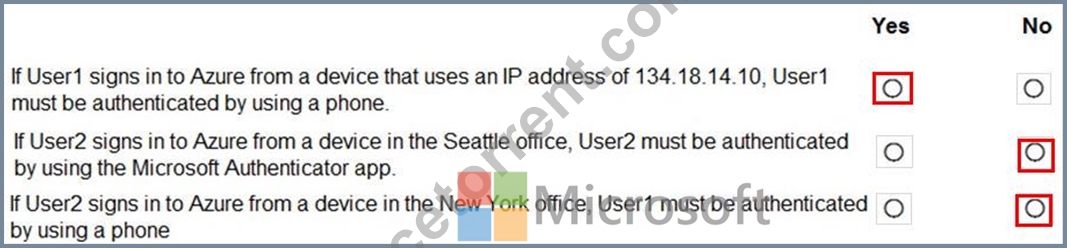
Reference:
https://www.cayosoft.com/difference-enabling-enforcing-mfa/
NEW QUESTION # 304
......
Microsoft AZ-500 Exam Dumps [2025] Practice Valid Exam Dumps Question: https://examcollection.vcetorrent.com/AZ-500-valid-vce-torrent.html