

CNX-001 Exam Questions - Real & Updated Questions PDF
Pass Guaranteed Quiz 2026 Realistic Verified Free CompTIA
CompTIA CNX-001 Exam Syllabus Topics:
| Topic | Details |
|---|---|
| Topic 1 |
|
| Topic 2 |
|
| Topic 3 |
|
| Topic 4 |
|
NEW QUESTION # 16
A company is experiencing numerous network issues and decides to expand its support team. The new junior employees will need to be onboarded in the shortest time possible and be able to troubleshoot issues with minimal assistance. Which of the following should the company create to achieve this goal?
- A. Clearly documented runbooks for networking issues and knowledge base articles
- B. Statement of work documenting what each junior employee should do when troubleshooting
- C. Physical and logical network diagrams of the entire networking infrastructure
- D. A mentor program for guiding each junior employee until they are familiar with the networking infrastructure
Answer: A
Explanation:
Comprehensive and Detailed Explanation From Exact Extract:
Runbooks and knowledge base articles provide step-by-step instructions for resolving common issues, helping new employees quickly become productive with minimal supervision. These documents can be updated as new issues arise and serve as a foundational training and operational resource.
Relevant Extract from CompTIA CloudNetX CNX-001 Study Guide - under "Operational Documentation and Knowledge Transfer":
"Runbooks contain standardized procedures for handling recurring operational tasks. Knowledge base articles enable consistent troubleshooting and resolution with minimal oversight." Other options:
* A. A Statement of Work (SOW) is used for defining project deliverables, not training.
* C. Network diagrams are useful for understanding architecture, but not for operational procedures.
* D. A mentor program can help, but it doesn't scale or provide immediate troubleshooting steps.
NEW QUESTION # 17
A network architect is designing an expansion solution for the branch office network and requires the following business outcomes:
* Maximize cost savings with reduced administration overhead
* Easily expand connectivity to the cloud
* Use cloud-based services to the branch offices
Which of the following should the architect do to best meet the requirements?
- A. Design a dark fiber solution for headquarters and branch offices' connectivity; deploy point-to-site VPN between headquarters and the cloud provider; use the headquarters connectivity to the cloud provider.
- B. Design a SD-WAN solution to integrate with the cloud provider; use SD-WAN to connect branch offices to the cloud provider.
- C. Design an MPLS architecture for the branch offices and site-to-site VPN between headquarters and branch offices; use site-to-site connectivity to the cloud provider.
- D. Design point-to-site branch connectivity for offices to headquarters; deploy ExpressRoute and/or DirectConnect between headquarters and the cloud; use headquarters connectivity to connect to the cloud provider.
Answer: B
Explanation:
Comprehensive and Detailed Explanation From Exact Extract:
SD-WAN (Software-Defined Wide Area Networking) is ideal for enterprises that want to simplify WAN management, reduce operational overhead, and optimize connectivity to cloudservices. SD-WAN provides intelligent traffic routing, dynamic path selection, and direct-to-cloud access without backhauling traffic through a central data center.
Relevant Extract from CompTIA CloudNetX CNX-001 Study Guide - under "SD-WAN and Cloud Connectivity":
"SD-WAN enables efficient cloud access from branch offices and simplifies management through centralized policy control. It is cost-effective and reduces the need for complex hardware configurations and manual routing." Other options:
* B. Adds latency and overhead by backhauling through headquarters.
* C. MPLS is expensive and less flexible than SD-WAN.
* D. Dark fiber is high-cost and not scalable for cloud-first architectures.
NEW QUESTION # 18
A cloud engineer is planning to build VMs in a public cloud environment for a cloud migration. A cloud security policy restricts access to the console for new VM builds. The engineer wants to replicate the settings for each of the VMs to ensure the network settings are preconfigured. Which of the following is the best deployment method?
- A. Custom SDK
- B. API script
- C. CLI command
- D. IaC template
Answer: D
Explanation:
Using an Infrastructure-as-Code template lets you define and version all VM configurations, including network settings, in code that's automatically applied during deployment, eliminating the need for console changes and ensuring consistency across each build.
NEW QUESTION # 19
After a company migrated all services to the cloud, the security auditor discovers many users have administrator roles on different services. The company needs a solution that:
Protects the services on the cloud.
Limits access to administrative roles.
Creates a policy to approve requests for administrative roles on critical services within a limited time.
Forces password rotation for administrative roles.
Audits usage of administrative roles.
Which of the following is the best way to meet the company's requirements?
- A. Access control list
- B. Privileged access management
- C. Conditional access
- D. Session-based token
Answer: B
Explanation:
A Privileged Access Management (PAM) solution provides just-in-time elevation to administrative roles, enforces approval workflows with time-bound access, requires credential rotation, and offers comprehensive auditing of all privileged sessions, fully meeting the company's requirements.
NEW QUESTION # 20
A company just launched a cloud-based application. Some users are reporting the application will not load. A cloud engineer investigates the issues and reports the following:
* Not all users are experiencing the issue.
* The application infrastructure is optimal.
* Users experiencing the issue belong to the company's remote sales team.
Which of the following is most likely misconfigured?
- A. Ports and protocols
- B. Geolocation rules
- C. Application load balancers
- D. IP addressing
Answer: B
Explanation:
Since only the remote sales team is affected and the infrastructure and network settings are correct, it's most likely that your geolocation or geo-restriction policies are blockingtraffic from the regions where those users are located. Correcting those rules to allow their locations should restore access without impacting other users.
NEW QUESTION # 21
A network architect is designing a solution to secure the organization's applications based on the security policy. The requirements are:
* Users must authenticate using one set of credentials.
* External users must be located in authorized sites.
* Session timeouts must be enforced.
* Network access requirements should be changed as needed.
Which of the following best meet these requirements? (Choose two.)
- A. Single sign-on
- B. Conditional access policy
- C. Static IP allocation
- D. Risk-based authentication
- E. Multifactor authentication
- F. Role-based access
Answer: A,B
Explanation:
Comprehensive and Detailed Explanation From Exact Extract:
B: Single Sign-On (SSO) - SSO enables users to authenticate once using a unified set of credentials and gain access to multiple applications. It improves user experience and simplifies identity management.
E: Conditional Access Policy - This supports dynamic enforcement of access policies based on user location, device, risk level, and session characteristics. It allows administrators to define rules such as only allowing access from authorized geographic regions and automatically enforcing session timeouts or requiring reauthentication.
Relevant Extract from CompTIA CloudNetX CNX-001 Study Guide - under "Identity and Access Management (IAM)":
"SSO provides seamless authentication across services while reducing password fatigue and attack surfaces."
"Conditional Access enforces access controls based on real-time conditions such as location, device compliance, and session context, supporting dynamic security postures." Other options:
* A. Role-based access defines permissions but does not handle location or session control.
* C. Static IP allocation does not offer user-based access controls.
* D. MFA enhances security but is not directly aligned with all the listed requirements.
* F. Risk-based authentication evaluates threat levels but does not handle session timeout or location enforcement directly.
NEW QUESTION # 22
A SaaS company's new service currently is being provided through four servers. The company's end users are having connection issues, which is affecting about 25% of the connections. Which of the following is most likely the root cause of this issue?
- A. The service is using weighted load balancing with 40% of the traffic on server A, 20% on server B,
20% on server C, and server D is down. - B. The service is using round-robin load balancing through a DNS server with one server down.
- C. The service is using a least-connection load-balancing method with one server down.
- D. Load balancing is configured with a health check in front of these servers, and one of these servers is unavailable.
Answer: B
Explanation:
Comprehensive and Detailed Explanation From Exact Extract:
Round-robin DNS is a simplistic form of load balancing that does not perform health checks. If one of the four servers is down, DNS will still resolve its IP to 25% of users, resulting in failed connections. This matches the symptom of 25% failure rate - 1 out of 4.
Relevant Extract from CompTIA CloudNetX CNX-001 Study Guide - under "Load Balancing Techniques and Availability":
"Round-robin DNS distributes requests without regard for health status. Without external health checks, failed servers will continue to receive traffic, leading to partial service disruptions." Other options:
* B. The percentages do not align with a 25% failure rate.
* C. Least-connection algorithms usually have integrated health checks.
* D. If health checks are active, the load balancer would not forward requests to a failed server.
NEW QUESTION # 23
A network administrator is configuring firewall rules to lock down the network from outside attacks. Which of the following should the administrator configure to create the most strict set of rules?
- A. URL filtering
- B. File blocking
- C. Network security group
- D. Allow List
Answer: D
Explanation:
Comprehensive and Detailed Explanation From Exact Extract:
An Allow List (also known as Whitelisting) is the most restrictive firewall rule approach. It blocks all traffic by default and only permits explicitly defined trusted IPs, URLs, or applications. This minimizes the attack surface and ensures that only known, safe traffic is allowed into the network.
Relevant Extract from CompTIA CloudNetX CNX-001 Study Guide - under "Firewall and Security Rule Configuration":
"Whitelisting or Allow Listing enforces a default-deny security posture by permitting only specified trusted sources. This approach offers the highest level of control and reduces exposure to unknown threats." Other options:
* A. URL filtering restricts content access but is not as strict as allow lists.
* B. File blocking targets malicious payloads but doesn't limit traffic sources.
* C. Network Security Groups (NSGs) are effective but broader in scope; they use allow/deny rules but may not be as tightly controlled as explicit allow lists.
NEW QUESTION # 24
A network load balancer is not correctly validating a client TLS certificate. The network architect needs to validate the certificate installed on the load balancer before progressing. Which of the following commands should the architect use to confirm whether the private key and certificate match?
- A. openssl x509 -noout -modulus -in cert.crt | openssl md5
openssl rsa -noout -modulus -in privkey.txt | openssl md5 - B. openssl-rsa -noout -modulus -in cert.crt | openssl md5
openssl-verify -noout -modulus -in privkey.txt | openssl md5 - C. openssl-list -noout -modulus -in cert.crt | openssl md5
openssl rsa -noout -modulus -in privkey.txt | openssl md5 - D. openssl req -in certificate.csr -verify
openssl-verify -noout -modulus -in privkey.txt | openssl md5
Answer: A
Explanation:
Comprehensive and Detailed Explanation From Exact Extract:
To verify that the certificate and the private key match, one can extract the modulus from both files and compare their hash values. The correct syntax involves using openssl x509 to extract the modulus from the certificate, and openssl rsa to extract the modulus from the private key, followed by an MD5 hash to ensure they match.
Relevant Extract from CompTIA CloudNetX CNX-001 Study Guide - under "TLS/SSL Certificate Validation and Troubleshooting":
"To verify that the private key and certificate match, compare the modulus values. A mismatch results in failed TLS handshakes." Other options:
* A & C: Incorrect syntax (openssl-list and openssl-rsa are not valid commands).
* B: The commands shown are used to verify CSRs, not matching keys.
NEW QUESTION # 25
New devices were deployed on a network and need to be hardened.
INSTRUCTIONS
Use the drop-down menus to define the appliance-hardening techniques that provide themostsecure solution.
If at any time you would like to bring back the initial state of the simulation, please click the Reset All button.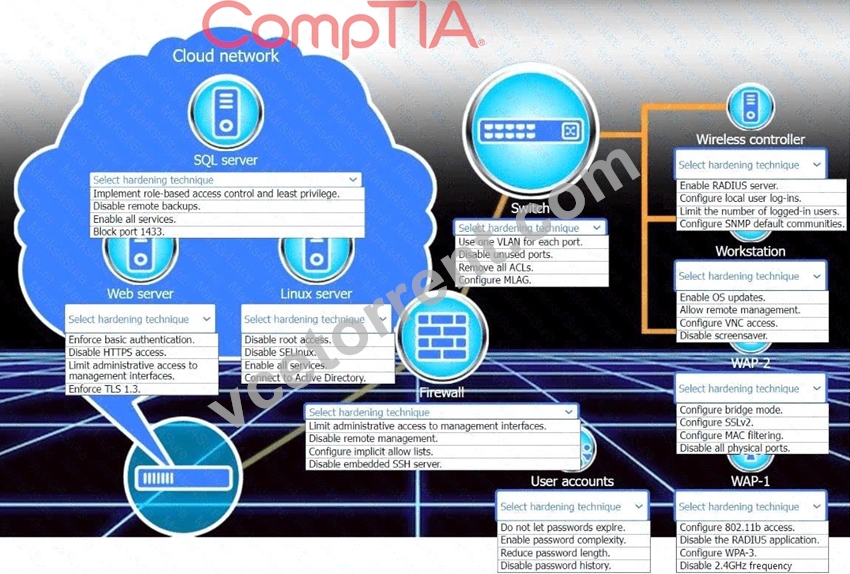
Answer:
Explanation: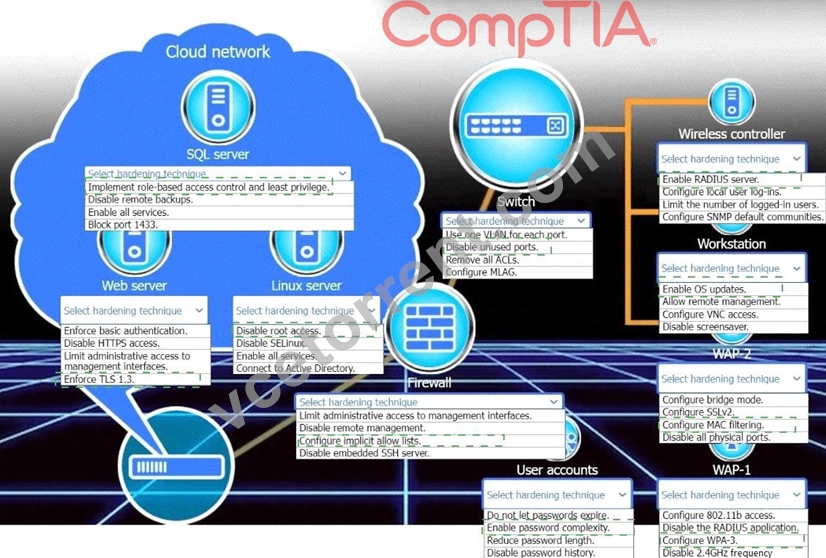
Explanation:
C:\Users\Waqas Shahid\Desktop\Mudassir\Untitled.jpg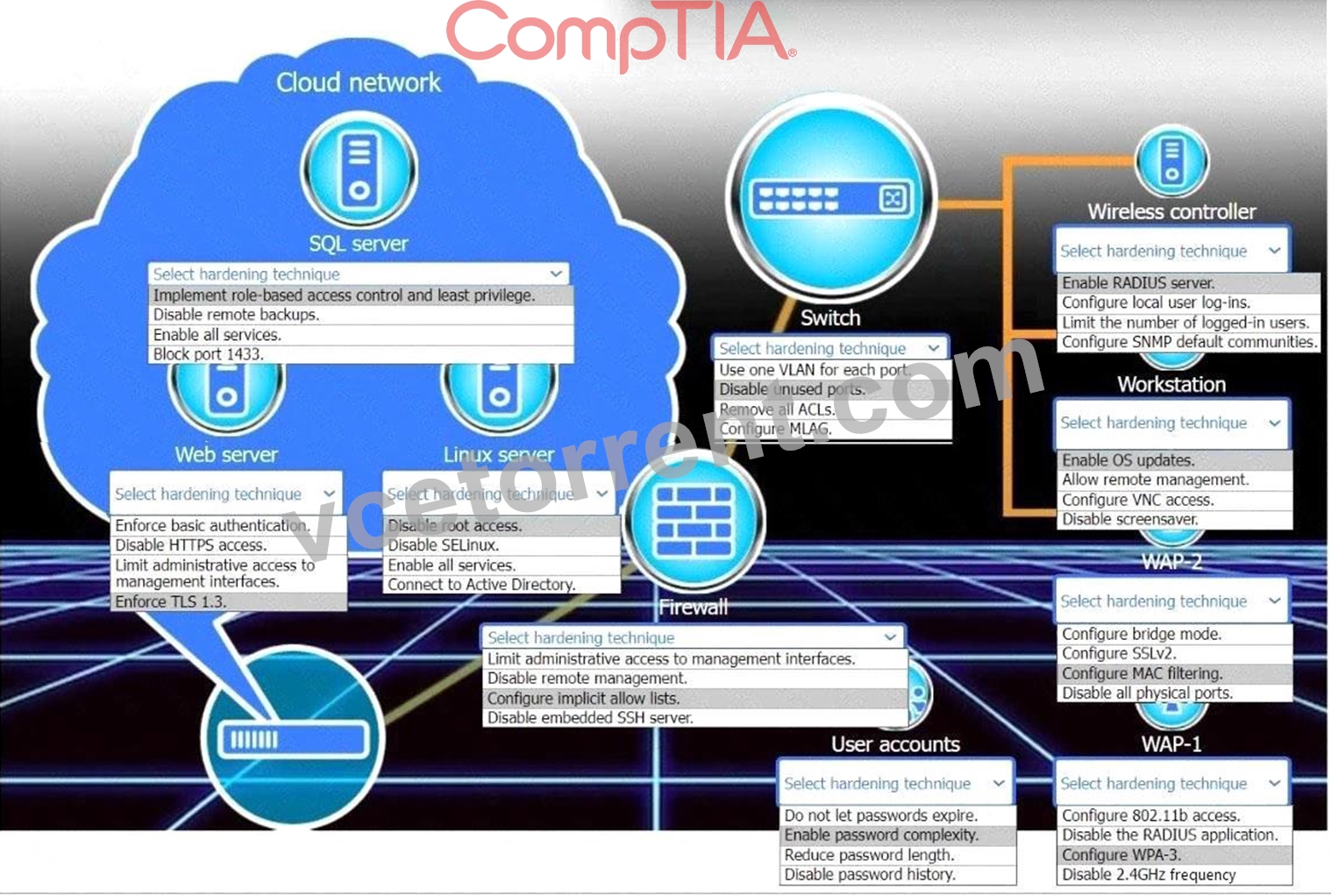
NEW QUESTION # 26
A network architect is creating a network topology for a global SD-WAN deployment. The business has offices in Asia, Europe, and the United States and makes use of data centers in the United States and Europe.
Most traffic between sites must have the lowest latency possible. Which of the following topologies best meets this requirement?
- A. Mesh
- B. Spine-and-leaf
- C. Hub-and-spoke
- D. Star
Answer: A
Explanation:
A full-mesh SD-WAN topology allows each site to establish direct overlays with every other site, minimizing the number of hops and avoiding backhauling through a central hub, thereby delivering the lowest latency paths between Asia, Europe, and the US.
NEW QUESTION # 27
An architecture team needs to unify all logging and performance monitoring used by global applications across the enterprise to perform decision-making analytics. Which of the following technologies is the best way to fulfill this purpose?
- A. Relational database
- B. Data lake
- C. CIEM
- D. Content delivery network
Answer: B
Explanation:
Comprehensive and Detailed Explanation From Exact Extract:
A data lake is ideal for aggregating structured and unstructured data at scale. It supports storage and analysis of logs, performance metrics, and other telemetry data from various sources. Data lakes enable advanced analytics and machine learning for decision support.
Relevant Extract from CompTIA CloudNetX CNX-001 Study Guide - under "Data Aggregation and Analytics":
"Data lakes allow storage and analysis of high-volume, diverse data types, including logs and monitoring data. They support enterprise-wide visibility and strategic decision-making." Other options:
* A. Relational databases are optimized for structured data and are less scalable for log aggregation.
* B. CDNs deliver content, not used for data aggregation.
* C. CIEM (Cloud Infrastructure Entitlement Management) governs cloud permissions, not logging.
NEW QUESTION # 28
A cafe uses a tablet-based point-of-sale system. Customers are complaining that their food is taking too long to arrive. During an investigation, the following is noticed:
* Every kitchen printer did not print the orders
* Payments are processing correctly
* The cloud-based system has record of the orders
* This issue occurred when the cafe was busy
Which of the following is the best way to mitigate this issue?
- A. Assigning the kitchen printers static IP addresses
- B. Updating the application
- C. Upgrading the kitchen printers' wireless dongles
- D. Adding an access point exclusively for the kitchen
Answer: D
Explanation:
Comprehensive and Detailed Explanation From Exact Extract:
Since payments are working and orders are being recorded in the cloud, the issue likely lies in the local wireless network between the tablets and the kitchen printers. If the issue only occurs during high usage periods, it's likely a congestion or signal quality issue. Adding a dedicated access point for the kitchen can isolate printer traffic and improve reliability.
Relevant Extract from CompTIA CloudNetX CNX-001 Study Guide - under "Wireless Performance and Interference Management":
"Segmenting traffic or deploying dedicated APs for mission-critical devices can reduce contention and ensure reliability in congested wireless environments." Other options:
* A. App updates won't fix wireless interference.
* C. Dongle upgrades may help but don't isolate the traffic.
* D. Static IPs help with addressing, not with wireless reliability.
NEW QUESTION # 29
A network architect needs to design a solution to ensure every cloud environment network is built to the same baseline. The solution must meet the following requirements:
Use automated deployment.
Easily update multiple environments.
Share code with a community of practice.
Which of the following are the best solutions? (Choose two.)
- A. Automated image deployment
- B. Deployment guides
- C. CI/CD pipelines
- D. Private code repository
- E. Deployment runbooks
- F. Public code repository
Answer: C,F
Explanation:
CI/CD pipelines: Automate the provisioning and configuration of network baselines across all environments, and make it easy to roll out updates consistently.
Public code repository: Enables your community of practice to collaborate, review, and contribute to shared IaC modules and templates, while making updates discoverable and reusable.
NEW QUESTION # 30
An outage occurred after a software upgrade on core switching. A network administrator thinks that the firmware installed had a bug. Which of the following should the network administrator do next?
- A. Establish a plan of action to resolve the issue.
- B. Test the theory to determine cause.
- C. Implement the solution.
- D. Document lessons learned.
Answer: B
Explanation:
Comprehensive and Detailed Explanation From Exact Extract:
According to the structured troubleshooting methodology outlined in the CNX-001 objectives, once a potential root cause is identified (in this case, a suspected firmware bug), the next step is to test the theory to confirm the cause before taking action. This helps prevent misdiagnosis and unnecessary configuration changes.
Relevant Extract from CompTIA CloudNetX CNX-001 Study Guide - under "Structured Troubleshooting Methodology":
"After identifying symptoms and forming a theory of probable cause, the next step is to test the theory to verify it is the actual cause of the problem." Other options:
* A. Establishing a plan of action comes after confirming the cause.
* C. Documenting lessons learned is the final step.
* D. Implementing the solution should only occur after the issue is confirmed.
NEW QUESTION # 31
A network architect must ensure only certain departments can access specific resources while on premises.
Those same users cannot be allowed to access those resources once they have left campus. Which of the following would ensure access is provided according to these requirements?
- A. Configuring geofencing with the IPs of the resources
- B. Enabling MFA for only those users within the departments needing access
- C. Implementing a PKI-based authentication system to ensure access
- D. Configuring UEBA to monitor all access to those resources during non-business hours
Answer: A
Explanation:
By defining an IP-based geofence around the on-premises network addresses where those resources reside, you ensure that only users connecting from inside the campus IP ranges can reach them. As soon as the same users leave that network (and thus fall outside the geofenced IP block), access is automatically denied.
NEW QUESTION # 32
A company is expanding its network and needs to ensure improved stability and reliability. The proposed solution must fulfill the following requirements:
* Detection and prevention of network loops
* Automatic configuration of ports
* Standard protocol (not proprietary)
Which of the following protocols is the most appropriate?
- A. BGP
- B. STP
- C. RTSP
- D. SIP
Answer: B
Explanation:
Comprehensive and Detailed Explanation From Exact Extract:
STP (Spanning Tree Protocol) is a Layer 2 standard protocol that prevents switching loops in Ethernet networks by creating a loop-free logical topology. It can automatically block and unblock redundant paths based on network changes, ensuring reliability and avoiding broadcast storms.
Relevant Extract from CompTIA CloudNetX CNX-001 Study Guide - under "Ethernet Loop Prevention and Switching Protocols":
"STP is a standard Layer 2 protocol used to detect and prevent network loops, enhancing network stability in switched topologies." Other options:
* B. SIP is a signaling protocol used in VoIP.
* C. RTSP is for media streaming control.
* D. BGP is a routing protocol, not for Layer 2 loop prevention.
NEW QUESTION # 33
A network engineer is installing new switches in the data center to replace existing infrastructure. The previous network hardware had administrative interfaces that were plugged into the existing network along with all other server hardware on the same subnet. Which of the following should the engineer do to better secure these administrative interfaces?
- A. Connect the switch management ports to a separate physical network.
- B. Disable unused physical ports on the switches to keep unauthorized users out.
- C. Set the administrative interfaces and the network switch ports on the same VLAN.
- D. Upgrade all of the switch firmware to the latest hardware levels.
Answer: A
Explanation:
Segregating management interfaces onto their own dedicated network ensures that administrative access is isolated from general user and server traffic, greatly reducing the attack surface and preventing lateral movement if the production network is compromised.
NEW QUESTION # 34
A user reports an issue connecting to a database server. The front-end application for this database is hosted on the company's web server. The network engineer has changed the network subnet that the company servers are located on along with the IP addresses of the servers. These are the new configurations:
New subnet for the servers is 10.10.10.64/27
Web server IP address is 10.10.10.101
Database server IP is 10.10.10.93
Which of the following ismostlikely causing the user's issue?
- A. The web server does not have the correct network configuration.
- B. The DNS server is not resolving properly.
- C. The web application server is not forwarding the requests.
- D. The database server firewall is blocking the port to the database.
Answer: A
Explanation:
With a /27 mask on 10.10.10.64/27, valid host addresses run from 10.10.10.65 through 10.10.10.94. The database server's IP (10.10.10.93) is in that range, but the web server's IP (10.10.10.101) falls outside it-so it's mis-configured and cannot reach the database.
NEW QUESTION # 35
......
Get to the Top with CNX-001 Practice Exam Questions: https://examcollection.vcetorrent.com/CNX-001-valid-vce-torrent.html