

[Jun 23, 2026] Lesson Brilliant PDF for the UiPath-ADPv1 Tests Free Updated Today
Get New 2026 Valid Practice UiPath Certified Professional - Developer Track UiPath-ADPv1 Q&A - Testing Engine
UiPath UiPath-ADPv1 Exam Syllabus Topics:
| Topic | Details |
|---|---|
| Topic 1 |
|
| Topic 2 |
|
| Topic 3 |
|
| Topic 4 |
|
NEW QUESTION # 64
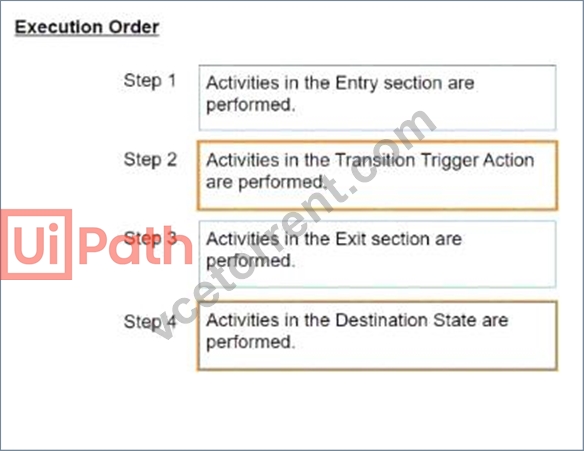
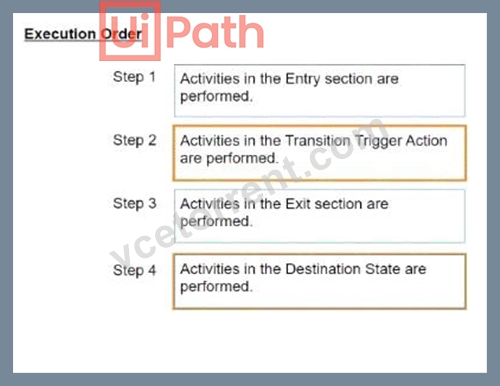
What is the correct execution order of the State activity sections?
instructions: Drag the Description found on the "Left" and drop on the correct Execution Order found on the
"Right"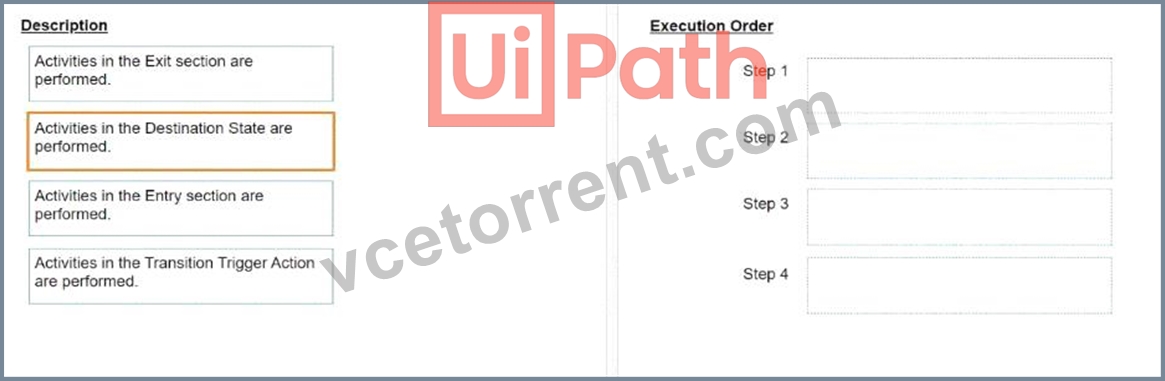
Answer:
Explanation: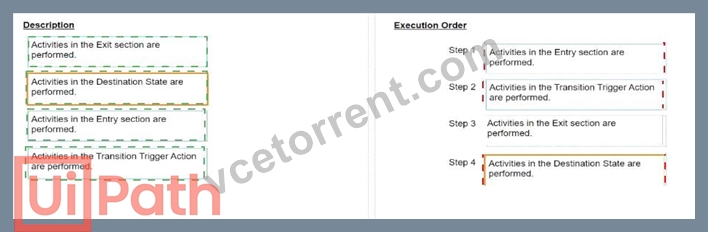
NEW QUESTION # 65
What are the primary functions of the UiPath Integration Service?
- A. Enables automation with API integration, manages connections with user-provided authentication, kicks off automations based on application-specific triggers, simplifies automation design with the help of third-party libraries.
- B. Automates Ul design, manages API connections, provides limited activities and events, simplifies automation design.
- C. Enables automation with a library of connectors, manages connections easily with standardized authentication, kicks off automations with server-side triggers or events, provides curated activities and events, simplifies automation design.
- D. Enables automation with Ul components, manages API keys, kicks off automations with client-side triggers, provides curated events.
Answer: C
Explanation:
UiPath Integration Service is a component of the UiPath Platform that allows users to automate third-party applications using both UI and API integration. It has the following primary functions1:
* Enables automation with a library of connectors: Connectors are pre-built API integrations that provide a consistent developer experience and simplify the integration process. Users can browse and import connectors from the Connector Catalog or the UiPath Marketplace, or create their own connectors using the Connector Builder (Preview).
* Manages connections easily with standardized authentication: Users can create and manage secure connections to various applications using standardized authentication methods, such as OAuth 2.0, Basic, API Key, etc. Users can also share connections with other users, groups, or automations within the UiPath Platform.
* Kicks off automations with server-side triggers or events: Users can trigger automations based on events from external applications, such as webhooks, email, or schedules. Users can also configure parameters and filters for the events to customize the automation logic.
* Provides curated activities and events: Users can access a set of curated activities and events that are specific to each connector and application. These activities and events can be used in UiPath Studio or UiPath StudioX to design and execute automations.
* Simplifies automation design: Users can leverage the UiPath Integration Service Designer to create and test integrations in a graphical interface. Users can also import common API formats, such as Swagger, YAML, or Postman collections, to generate connectors automatically.
References:
1: Integration Service - Introduction - UiPath Documentation Portal
NEW QUESTION # 66
What is a pre-requisite for running functional test cases in REFramework?
- A. Invoke Process XAML file
- B. Invoke InitAIISettings XAML file
- C. Invoke SetTransactionStatus XAML file
- D. Invoke Main XAML file
Answer: B
NEW QUESTION # 67
In the Robotic Enterprise (RE) Framework, at which point should a developer log a clear message with the Logging Level set to "Information," adhering to the best practices for automating a production-level process?
- A. Whenever an exception is caught in a Catch block.
- B. Whenever an argument or value is used.
- C. Whenever the robot encounters an error on a Queue Item.
- D. Whenever data is fetched from external sources.
Answer: D
NEW QUESTION # 68
What is the correct sequence of steps in a REFramework project that is linked to Orchestrator it an application exception occurs on a Queue Item m the Process Transaction stale?
Instructions: Drag the Description found on the "Left" and drop on the correct Step Sequence found on the Right".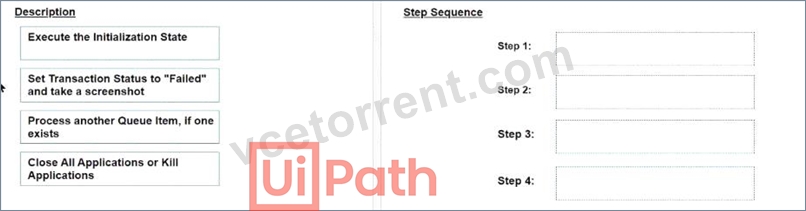
Answer:
Explanation: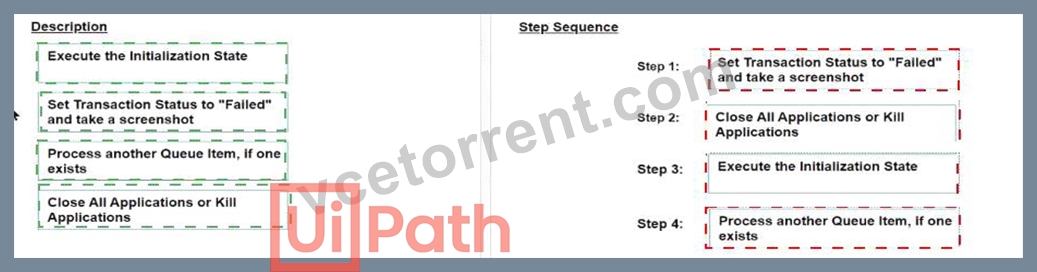
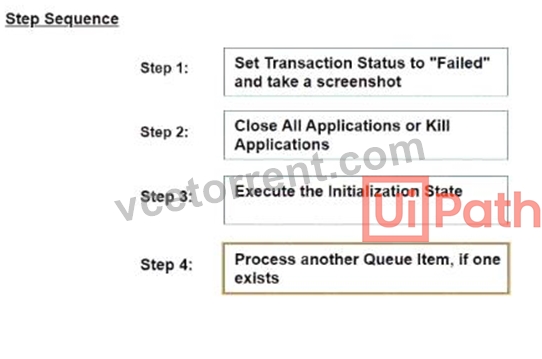
NEW QUESTION # 69
What are the differences between the properties Input mode: Simulate and Input mode: Window Messages on a Type Into activity?
- A. Input mode: Simulate works best with web applications.
Input mode: Window Messages is the fastest and supports hotkeys. - B. Input mode: Simulate is compatible with all applications.
Input mode: Window Messages runs in the background and auto-empties the field. - C. Input mode: Simulate is the fastest and supports hotkeys.
Input mode: Window Messages is compatible with all applications. - D. Input mode: Simulate runs in the background and auto-empties the field.
Input mode: Window Messages supports hotkeys.
Answer: D
Explanation:
In UiPath, the Type Into activity's Input Mode property determines how text is typed into a target UI element.
The "Simulate" input mode types text using the technology of the target application, allowing it to run in the background without needing the target UI element to be in focus. It also automatically clears the field before typing, unless otherwise specified. On the other hand, the "Window Messages" input mode sends a series of Windows messages to the target application, simulating keyboard strokes. This mode supports the use of hotkeys and special key combinations, making it suitable for applications that require specific keyboard inputs to trigger actions.References:
UiPath Activities Guide - Type Into
NEW QUESTION # 70
In the Global Exception Handler, which arguments are provided by default and should not be removed?
- A. errorinfo with the "In" direction result with the *ln/Ouf direction
- B. errorinfo with the "In" direction result with the "Out" direction
- C. errorinfo with the "In" direction result with the "In" direction
- D. errorinfo with the "Out" direction result with the "In/Out" direction
Answer: B
Explanation:
The Global Exception Handler is a type of workflow that determines the project's behavior when encountering an execution error. It has two arguments that are provided by default and should not be removed. They are:
* errorinfo: This argument has the "In" direction and it stores information about the error that was thrown and the workflow that failed. It can be used to log the error details, get the name of the activity that caused the error, or count the number of retries1.
* result: This argument has the "Out" direction and it is used to specify the next action of the process when it encounters an error. It can have one of the following values: Continue, Ignore, Retry, or Abort. These values determine whether the exception is re-thrown, ignored, retried, or stops the execution1.
The other options are not correct, because they either have the wrong direction for the arguments, or they use the "In/Out" direction, which is not valid for the Global Exception Handler arguments1.
References:
1: Studio - Global Exception Handler - UiPath Documentation Portal
NEW QUESTION # 71
What is the correct execution order of the State activity sections?
instructions: Drag the Description found on the "Left" and drop on the correct Execution Order found on the
"Right"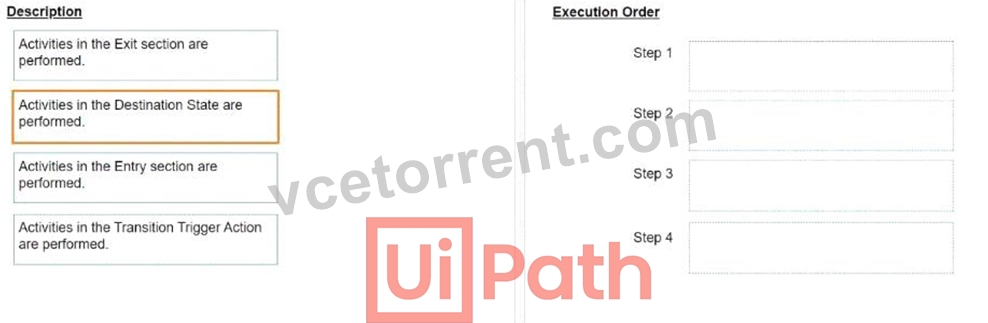
Answer:
Explanation: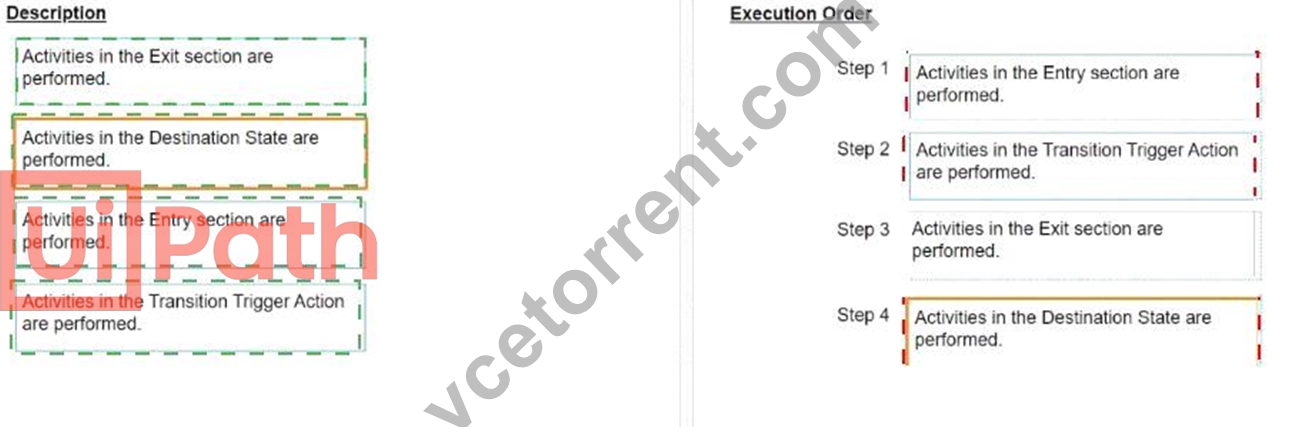
NEW QUESTION # 72
You need to create a process where multiple events happen at the same time, and triggers must handle these events simultaneously in an attended automation.
How can you set up this parallel execution of triggers?
- A. Use the Enable Local Trigger activity to run all triggers at the same time once they are enabled.
- B. Use the Trigger Scope activity to handle all events in a sequential manner rather than parallel.
- C. Rely on the Form Builder to set up multiple events and manage their execution based on user input.
- D. Use the Run Local Triggers activity to manage the simultaneous execution of multiple triggers within the project.
Answer: D
Explanation:
To allowparallel execution of multiple local triggers, UiPath provides theRun Local Triggersactivity. It monitors all defined triggerssimultaneouslyand allows the automation toreact to whichever is activated first, supporting more dynamic and responsive attended automation solutions.
Reference:UiPath Activities Guide > Triggers > Run Local Triggers
NEW QUESTION # 73
How should the computation of the signature be done for client apps that receive Orchestrator requests and need to check their authenticity?
Instructions: Drag the Description found on the left and drop on the correct Step Sequence found on the right.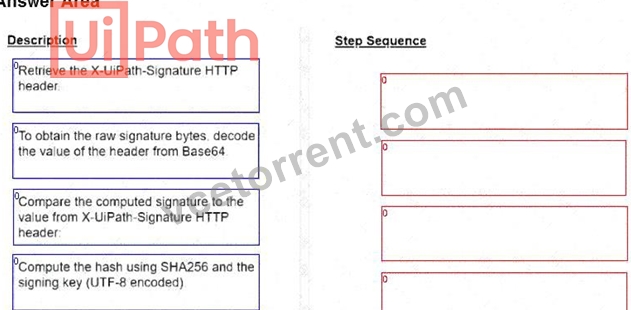
Answer:
Explanation: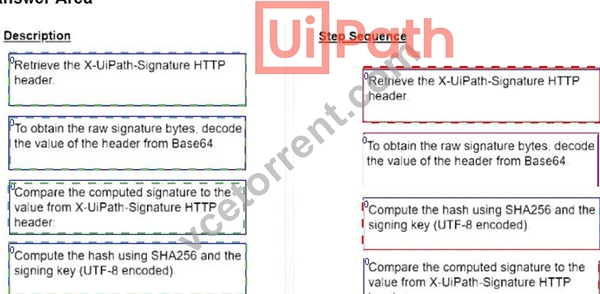
Explanation: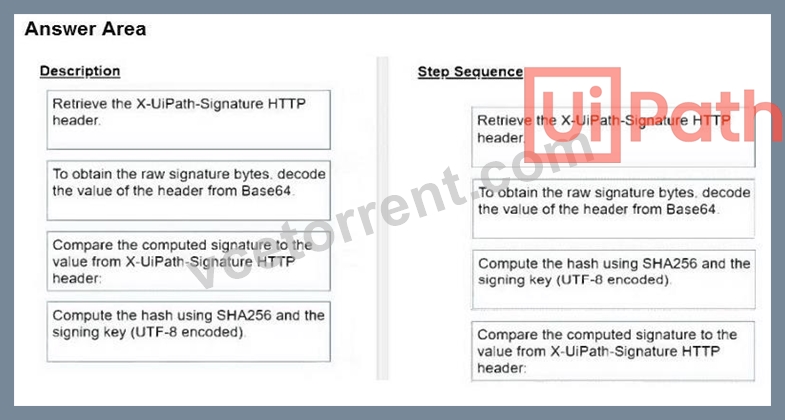
NEW QUESTION # 74
A developer is working on an automation using the REFramework. Each transaction item represents a piece of client information. For each customer, the automated procedure must click the "Generate Shipment Details" button. This generates a table of shipment records for each customer.
What type of exception occurs when the data is not accessible, the created table displays only the header row, and processing for that client must be halted?
- A. ApplicationException
- B. BusinessRuleException
- C. NullReferenceException
- D. SystemException
Answer: B
Explanation:
When the data is not accessible, the created table displays only the header row, and processing for that client must be halted, a BusinessRuleException occurs. A BusinessRuleException is a type of exception that indicates a business logic error or a validation error that cannot be resolved by retrying the transaction. For example, if the input data is incorrect, incomplete, or outdated, a BusinessRuleException should be thrown. A BusinessRuleException can be thrown by using the Throw activity with the following expression:
VB New BusinessRuleException("Message") where Message is a string that describes the error. A BusinessRuleException can be caught by using the Catch activity with the following expression:
VB ex As BusinessRuleException where ex is a variable that stores the exception object. A BusinessRuleException can be handled differently from other types of exceptions, such as SystemException or ApplicationException, depending on the logic of the automation. For example, in the REFramework, a BusinessRuleException sets the status of the transaction item to Failed and does not retry the transaction, whereas a SystemException sets the status of the transaction item to Retry and retries the transaction up to a specified number of times. References: [BusinessRuleException], [Throw], [Catch], [REFramework]
NEW QUESTION # 75
A developer is building an automation that must interact with a destination remote computer reached by jumping through multiple RDP connections, as described by the following scenario:
- The Robot is installed on Machine A, which connects through RDP to Machine B.
- From Machine B another RDP connection is opened to Machine C, where the automation must be performed.
Which of the following scenarios is appropriate for the developer who wants to use UI Automation activities?
- A. UI Automation can be used and the following are prerequisites:
Machine A - install RDP extension.
Machine B - no requirement.
Machine C - install RemoteRuntime.msi. - B. UI Automation can be used and the following are prerequisites:
Machine A - install RDP extension.
Machine B - install RDP extension and RemoteRuntime.msi.
Machine C - install RemoteRuntime.msi. - C. UI Automation can be used and the following are prerequisites:
Machine A - no requirement.
Machine B - no requirement.
Machine C - install RemoteRuntime.msi. - D. UI Automation can be used and the following are prerequisites:
Machine A - install RDP extension.
Machine B - install RemoteRuntime.msi.
Machine C - install RemoteRuntime.msi.
Answer: B
Explanation:
To use UI Automation activities in a scenario where the destination remote computer is reached by jumping through multiple RDP connections, the following prerequisites are required:
Machine A - install the RDP extension. This extension enables the robot to generate native selectors over RDP connections and interact with the UI elements on the remote machines.
Machine B - install the RDP extension and the RemoteRuntime.msi. The RDP extension allows the robot to connect to Machine C from Machine B, while the RemoteRuntime component enables the communication between the robot and the UI elements on Machine B.
Machine C - install the RemoteRuntime.msi. This component enables the communication between the robot and the UI elements on Machine C, where the automation must be performed. References:
[Remote Runtime Architecture], [Multiple RDP Connections], [UiPath Extension for Microsoft Remote Desktop and Apps]
NEW QUESTION # 76
Starting with UiPath Studio version 2022.10, what happens to dependencies that lack Windows compatibility when they are converted in a project?
- A. They are removed from the project.
- B. They are replaced with compatible alternatives.
- C. They are automatically resolved.
- D. They are marked as unresolved.
Answer: D
Explanation:
Starting with UiPath Studio version 2022.10, dependencies that lack Windows compatibility are marked as unresolved when they are converted in a project. This means that the project cannot be executed until the unresolved dependencies are manually resolved by the developer. This is done to ensure that the project can run on both Windows and Linux platforms without compatibility issues. References: [UiPath Studio Guide - Converting Projects to Linux Compatibility]
NEW QUESTION # 77
At indication time, the Strict Selector has the following functionalities available:
- A. Refresh, Open in UiExplorer, Copy to clipboard.
- B. Accuracy, Open in UiExplorer, Copy to clipboard. Show all matches.
- C. Ignore text. Copy to clipboard. Show all matches.
- D. Open in UiExplorer, Copy to clipboard, Show all matches.
Answer: D
Explanation:
The Strict Selector is a targeting method that uses the selector information of a UI element to identify it on the screen. It is one of the four targeting methods available in UiPath Studio, along with Fuzzy Selector, Image, and Computer Vision1. The Strict Selector is considered to be the most reliable and stable targeting method, as it uses the attributes and properties of the UI element that are unlikely to change2.
At indication time, the Strict Selector has the following functionalities available:
* Open in UiExplorer: This option opens the UiPath Explorer window, where you can inspect and edit the selector information of the indicated UI element, as well as use advanced features such as anchors, wildcards, variables, and regex3.
* Copy to clipboard: This option copies the selector information of the indicated UI element to the clipboard, so you can paste it elsewhere, such as in a text editor or another activity.
* Show all matches: This option highlights all the UI elements on the screen that match the selector information of the indicated UI element. This helps you to check if there are any duplicates that might cause the automation to fail at runtime. You can also use the Ignore text option to exclude the text attribute from the selector information, which might reduce the number of matches4.
The other options are incorrect because:
* Option A is incorrect because it does not include the Show all matches option, which is available for the Strict Selector.
* Option B is incorrect because it does not include the Open in UiExplorer option, which is available for the Strict Selector.
* Option D is incorrect because it includes the Accuracy option, which is not available for the Strict Selector. The Accuracy option is only available for the Image targeting method, which allows you to adjust the similarity threshold between the indicated image and the target image5.
References:
* Studio - Targeting Methods - UiPath Documentation Portal
* Studio - Strict Selector - UiPath Documentation Portal
* Studio - UiPath Explorer - UiPath Documentation Portal
* Activities - Advanced descriptor configuration - UiPath Documentation Portal
* Studio - Image - UiPath Documentation Portal
NEW QUESTION # 78
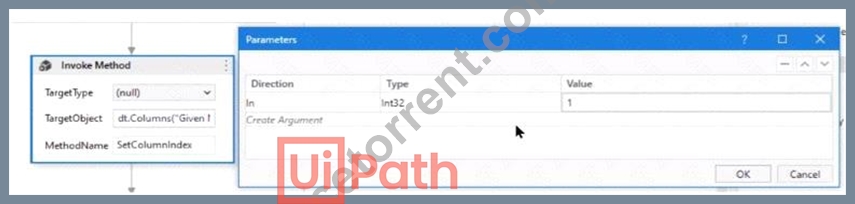
Given a dataiable "dt" with the following header:
"Surname. Address. Zip Code, Given Name, Phone Number.
What is the correct configuration of the Invoke Method activity so that the resulting header will be:
"Surname. Given Name. Address. Zip Code. Phone Number".
- A.
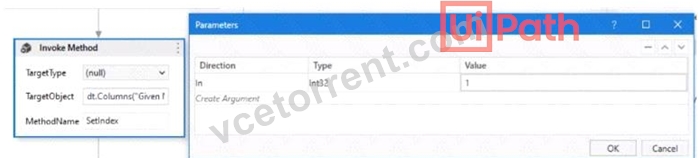
- B.
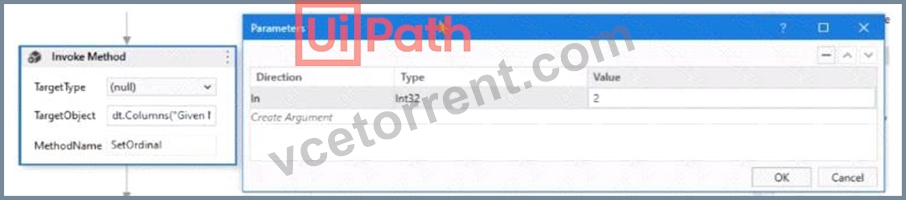
- C.
- D.
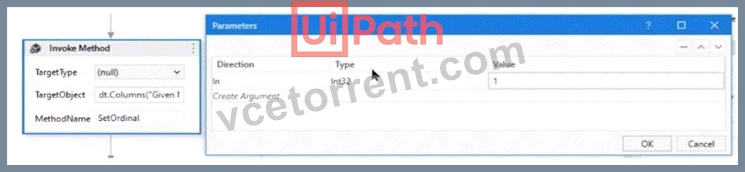
Answer: D
NEW QUESTION # 79
Considering that the attached table is stored in a variable called "dt":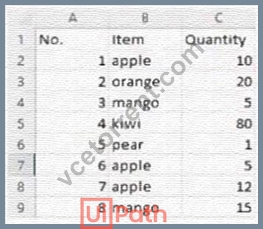
Which LINQ query can be used to return the maximum total Quantity?
- A. dt.AsEnumerable. Max(Function(x) Convert.ToInt32(x("Quantity").ToString))("Item")
- B. dt.AsEnumerable. GroupBy(Function(x) x("Item").ToString). Max(Function(x) x.Sum(Function(y) Convert.ToInt32(y("Quantity").ToString)))
- C. dt.AsEnumerable. Max(Function(x) Convert.ToInt32(x("Quantity").ToString))
- D. dt.AsEnumerable. OrderByDescending(Function(x) Convert.ToInt32(x("Quantity").ToString)).First.Item("Quantity")
Answer: B
Explanation:
The LINQ query that can be used to return the maximum total Quantity from the attached table is dt.AsEnumerable. GroupBy(Function(x) x("Item").ToString). Max(Function(x) x.Sum(Function(y) Convert.ToInt32(y("Quantity").ToString))). This query uses the LINQ methods AsEnumerable, GroupBy, Max, and Sum to manipulate the data in the dt variable. The dt variable is a DataTable that contains the following data:
No.
Item
Quantity
1
apple
10
2
orange
20
3
mango
50
4
kiwi
80
5
pear
1
6
apple
5
7
mango
15
The AsEnumerable method converts the DataTable into an Enumerable collection of DataRow objects. The GroupBy method groups the elements of the collection by the value of the Item column, creating a collection of groups. Each group has a key, which is the Item name, and a list of elements, which are the DataRows that have the same Item value. The Max method returns the maximum value of the collection, based on a selector function. The selector function is a lambda expression that calculates the sum of the Quantity column for each group. The Sum method returns the sum of the elements in a collection, based on a selector function. The selector function is a lambda expression that converts the value of the Quantity column into an integer.
Therefore, the query will group the DataRows by the Item name, calculate the total Quantity for each group, and return the maximum total Quantity among the groups. The maximum total Quantity is 80, which corresponds to the group with the key "kiwi". References: [DataTable.AsEnumerable Method],
[Enumerable.GroupBy Method], [Enumerable.Max Method], [Enumerable.Sum Method]
NEW QUESTION # 80
What is the purpose of The Relative To feature in Computer Vision activities?
- A. To compare the size and position of Ul elements in different applications.
- B. To configure the target as being relative to an element, either a single point or an area selection in the application.
- C. To create a fixed relationship between Computer Vision actions and Ul element positions.
- D. To synchronize the timing of multiple Computer Vision activities in the same project.
Answer: B
Explanation:
The Relative To feature in Computer Vision activities is used to configure the target as being relative to an element, either a single point or an area selection in the application. This feature enhances the accuracy and reliability of UI automation.
NEW QUESTION # 81
What is the main function of the UiPath Remote Runtime component?
- A. It introduces support for headless browser automation, so browser automation doesn't necessarily have to rely on visual elements on screen, such as window frames.
- B. It enables the use of OCR and image recognition activities on remote applications or desktops, without any extensions, allowing selectors to be natively generated in UiExplorer.
- C. It facilitates the communication between a remote application or desktop and the dedicated UiPath extension, allowing selectors to be natively generated in UiExplorer.
- D. It allows automations to run on the user machine, in a different Windows session.
Answer: C
Explanation:
The UiPath Remote Runtime component is a component that facilitates the communication between a remote application or desktop, such as Citrix Virtual Apps, and the dedicated UiPath extension - the UiPath Extension for Citrix, the UiPath Extension for Windows Remote Desktop and Apps, or the UiPath Extension for VMware Horizon1. It gathers information about the targeted UI elements of the remote applications and sends them to the corresponding extension, so that selectors are natively generated in UiExplorer1. The UiPath Remote Runtime component is required to establish the connection between an application or desktop server and a corresponding UiPath extension installed on a client machine, where Studio is installed1. This way, selectors are natively generated on the client machine, without having to rely on OCR and image recognition activities1. .
NEW QUESTION # 82
A developer is building an automation which types text into a text file. The Activity Project Settings tor UI Automation Modern activities are set as follows: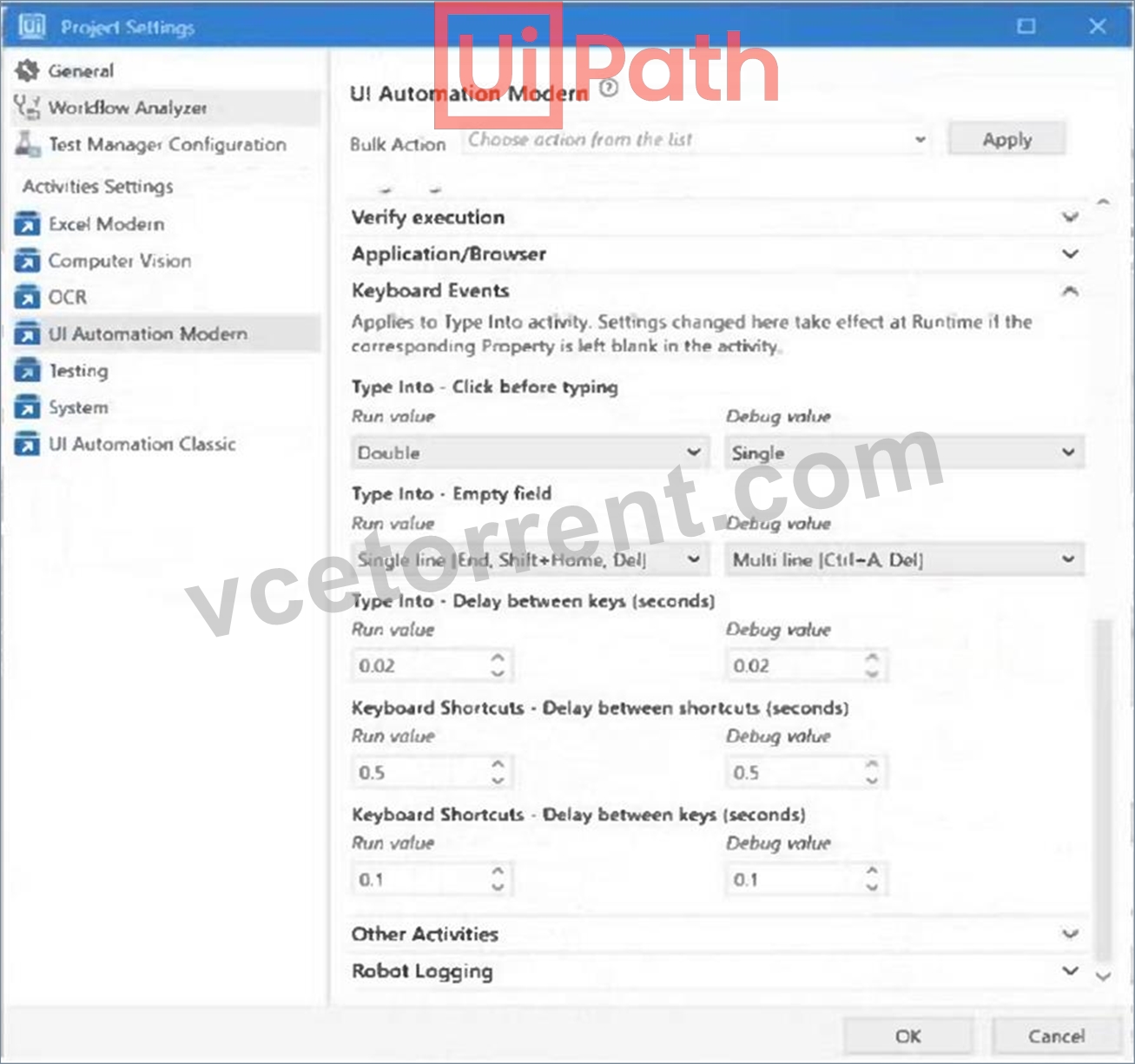
The developer has configured the properties of a Type Into activity as follows: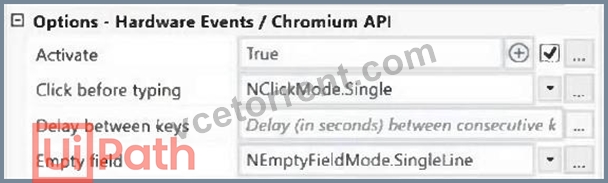
What is the behavior of the Type Into activity when executing the workflow?
- A. The activity will remove Multi Line in Run mode and a Single Line in Debug mode.
- B. The activity will remove a Single Line in Run mode and in Debug mode.
- C. The activity will remove a Single Line in Run mode and Multi Line in Debug mode.
- D. The activity will use only properties set in Activity Project Settings.
Answer: C
Explanation:
The behavior of the Type Into activity when executing the workflow is that the activity will remove a Single Line in Run mode and Multi Line in Debug mode. This is because the activity has the Empty field property set to NEmptyFieldMode.SingleLine, which means that the activity will delete the existing content in the field by sending Ctrl+A and Delete keystrokes before typing the text. However, the activity also has the Debug mode property set to NEmptyFieldMode.MultiLine, which means that the activity will delete the existing content in the field by sending Ctrl+A, Shift+Home, and Delete keystrokes before typing the text. The Debug mode property overrides the Empty field property when the workflow is executed in Debug mode. Therefore, the activity will use different keystrokes to empty the field depending on the mode of execution. References:
[Type Into], [Empty Field], [Debug Mode]
NEW QUESTION # 83
Considering a process developed using REFramework, if the status of a transaction was set to "Failed" with the ErrorType specified as "Business", the process will transition to which state?
- A. Process Transaction
- B. Initialization
- C. Get Transaction Data
- D. End Process
Answer: C
Explanation:
The REFramework is a project template based on State Machines, which follows the best practices regarding logging, exception handling, application initialization, and others1. The REFramework uses a queue in Orchestrator to store the transaction items, which are the units of data that need to be processed by the automation process1. The status of a transaction item can be set to Failed or Successful using the Set Transaction Status activity, which also allows specifying the ErrorType as Business or Application2. A Business ErrorType indicates that the transaction failed due to a business rule exception, such as invalid or incomplete data2. An Application ErrorType indicates that the transaction failed due to an application exception, such as a system error or a timeout2.
The REFramework has four main states: Init, Get Transaction Data, Process Transaction, and End Process1.
The process transitions between these states based on the conditions and triggers defined in the state machine1. The process starts with the Init state, where the application is initialized and the Config file is read1. Then, the process moves to the Get Transaction Data state, where the next transaction item is retrieved from the queue1. If there is a transaction item available, the process moves to the Process Transaction state, where the main logic of the automation is executed1. If the transaction is processed successfully, the status is set to Successful and the process returns to the Get Transaction Data state1. If the transaction fails due to a Business ErrorType, the status is set to Failed and the process also returns to the Get Transaction Data state, without retrying the transaction1. If the transaction fails due to an Application ErrorType, the status is set to Failed and the process retries the transaction until the maximum number of retries is reached1. If there is no transaction item available, or if the maximum number of retries is reached, or if a System Error occurs, the process moves to the End Process state, where the application is closed and the final report is generated1.
Therefore, considering a process developed using REFramework, if the status of a transaction was set to
"Failed" with the ErrorType specified as "Business", the process will transition to the Get Transaction Data state, where it will fetch the next transaction item from the queue.
NEW QUESTION # 84
The following table is stored in a variable called "dt".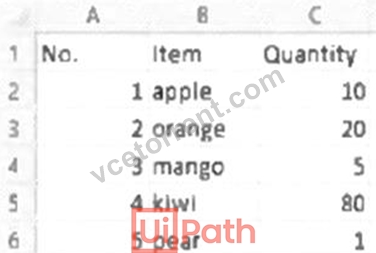
What will the value of the qty variable be after executing the Assign activity?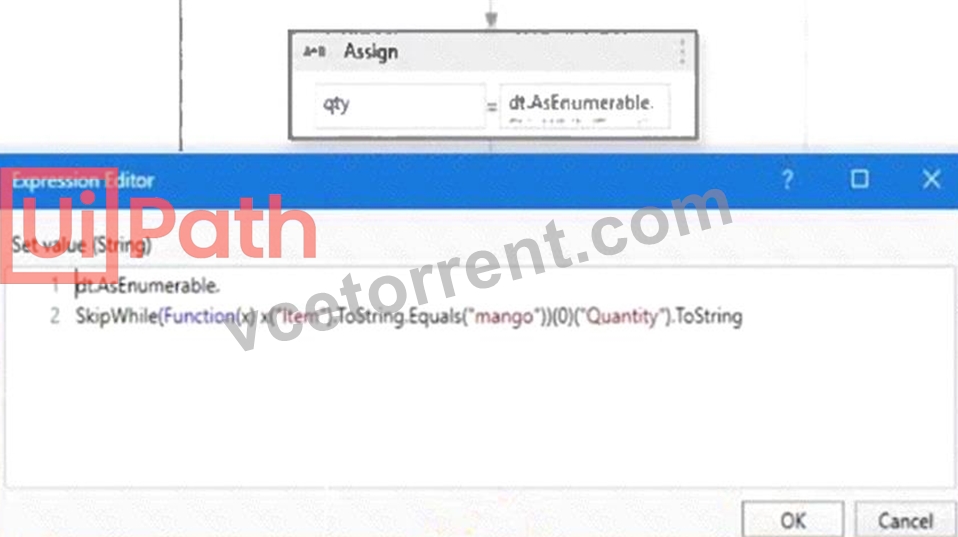
- A. 0
- B. 1
- C. 2
- D. null
Answer: C
Explanation:
The value of the qty variable will be 80 after executing the Assign activity. This is because the expression in the Assign activity is using the LINQ methods AsEnumerable, SkipWhile, and Item to access the data in the dt variable. The dt variable is a DataTable that contains the following data:
Item
Quantity
apple
5
banana
10
mango
20
orange
80
grape
40
The AsEnumerable method converts the DataTable into an Enumerable collection of DataRow objects. The SkipWhile method skips the elements of the collection until the condition is false. The condition is a lambda expression that checks if the value of the Item column is equal to "mango". The (0) indexer returns the first element of the collection after skipping. The Item method accesses the value of the Quantity column of the DataRow. The ToString method converts the value into a string. Therefore, the expression will skip the first three rows of the DataTable and return the value of the Quantity column of the fourth row, which is 80.
References: [DataTable.AsEnumerable Method], [Enumerable.SkipWhile Method], [DataRow.Item Property]
NEW QUESTION # 85
......
UiPath-ADPv1 Dumps PDF - 100% Passing Guarantee: https://examcollection.vcetorrent.com/UiPath-ADPv1-valid-vce-torrent.html