

Start your PMP Exam Questions Preparation with Updated 2134 Questions
A Fully Updated 2026 PMP Exam Dumps - PDF Questions and Testing Engine
The PMP certification exam is based on the PMI’s Project Management Body of Knowledge (PMBOK), which is a widely recognized standard for project management practices. The PMBOK is regularly updated to reflect changes and advancements in the field of project management. The latest version of the PMP certification exam, the 2023 version, will be based on the latest edition of the PMBOK.
NEW QUESTION # 903
Ensuring that both parties meet contractual obligations and that their own legal rights are protected is a function of:
- A. Administer Procurements,
- B. Close Procurements.
- C. Plan Procurements.
- D. Conduct Procurements.
Answer: A
NEW QUESTION # 904
Which of the following are false regarding corrective actions?
- A. Approved corrective are inputs to the direct and manage project execution process
- B. Corrective actions are used to bring expected future project performance in line with the project plan
- C. Corrective actions generally do not require root cause analysis ti identify the cause of
variation - D. Corrective actions are the outputs of process in the controlling process group
Answer: C
NEW QUESTION # 905
A project manager you are mentoring comes to you for help because he is about to face his first procurement audit. You might explain that he should NOT worry about such an audit because it:
- A. Identifies successes and failures that warrant transfer to other procurements.
- B. Makes sure the seller is following the contract.
- C. Makes sure costs are in line with the project.
- D. Makes sure the contract is being followed.
Answer: A
NEW QUESTION # 906
You are project manager of ABC company and you have to choose one project between two of them. Which of the following factor you would NOT cosider for the project selection?
- A. Opportunity cost
- B. Net present value (NPV)
- C. Resource Count
- D. Payback period
Answer: C
Explanation:
Option A, B and C all are project selection factor.
< li >Net present value (NPV): The present value of cash inflow less the present value of
cash outflow.
A negative NPV is unfavorable; the higher the NPV, the better.
< li > Opportunity cost: The difference in benefit received between a chosen project and a project that was not chosen < li >Payback period: The number of time periods required until inflows equal, or exceed, costs. The lower the payback period, the better
NEW QUESTION # 907
Which three of the following scenarios are impediments to which a scrum master should pay attention?
(Choose three)
- A. A team member talking about a user story that is on the Scrum board
- B. A lack of team empowerment and an inability to self-organize
- C. A technology that blocks agile capabilities
- D. A team member talking about a user story that is not on the Scrum board
- E. A review of the backlog at daily standup meetings
Answer: B,C,D
Explanation:
According to the Scrum Guide, an impediment is any factor that blocks or slows down the Developers in their creation of a valuable piece of software in a Sprint, or that restricts the team in achieving its intrinsic level of progress1. Therefore, the scenarios that are impediments are:
* A team member talking about a user story that is not on the Scrum board: This indicates that the team is not focused on the Sprint Goal and the Sprint Backlog, which are the sources of alignment and commitment for the Developers. Talking about a user story that is not on the Scrum board can also cause confusion, distraction, and waste of time for the team2.
* A technology that blocks agile capabilities: This implies that the team is facing a technical issue that prevents them from delivering a potentially releasable Increment of value at the end of the Sprint, or from collaborating effectively with the Product Owner and other stakeholders. A technology that blocks agile capabilities can also hinder the team's ability to inspect and adapt their work and process3.
* A lack of team empowerment and an inability to self-organize: This suggests that the team is not able to make decisions and take actions that are best suited for achieving the Sprint Goal and delivering value to the customer. A lack of team empowerment and an inability to self-organize can also affect the team' s motivation, creativity, and productivity.
The scenarios that are not impediments are:
* A team member talking about a user story that is on the Scrum board: This indicates that the team is engaged in the Sprint work and is discussing the details and progress of a user story that is part of the Sprint Backlog. Talking about a user story that is on the Scrum board can also foster communication, collaboration, and transparency within the team.
* A review of the backlog at daily standup meetings: This implies that the team is using the daily standup meetings as an opportunity to inspect the Sprint Backlog and adapt their plan accordingly. A review of the backlog at daily standup meetings can also help the team identify any impediments or risks that may affect their Sprint work.
: 1: Scrum Guide, November 2020, p. 9 2: The Scrum Master as an Impediment Remover, Scrum.org, April 2016, 1 3: Navigating Impediments, Scrum.org, October 2020, 2 : Solving Impediments as a Scrum Team, Scrum.org, August 2018, 3 : Scrum Guide, November 2020, p. 10 : Scrum Guide, November 2020, p. 11
NEW QUESTION # 908
You are the Project Manager on a cellular bluetooth amplifier project and are in the Planning phase. During a team meeting, a Functional Manager attempts to validate if the project meets company goals. The Functional Manager will report this finding back to senior management to determine if the project should continue, be modified or be canceled. What is this process called?
- A. Return on investment
- B. Management product analysis
- C. Delphi Technique
- D. Management by objectives (MBO).
Answer: D
NEW QUESTION # 909
A project manager is leading a regulatory project that involves multiple geographic locations and has a strict deadline, Although the company has no previous experience with this type of project, the stakeholders have approved it.
What tool or technique should the project manager use to address the lack of expertise?
- A. Benchmarking
- B. Market research
- C. Focus groups
- D. Brainstorming
Answer: C
NEW QUESTION # 910
Plan-do-check-act is also known as:
- A. continuous improvement.
- B. management responsibility.
- C. statistical sampling.
- D. prevention over inspection.
Answer: A
Explanation:
Section: Monitoring and Controlling
Explanation
NEW QUESTION # 911
A project is in the start-up phase of the project life cycle. The project team consists of 20 people from five different countries. The project team is scheduled to have quarterly face-to-face meetings. However, due to unforeseen circumstances, no face-to-face meetings can occur. The project manager is concerned that the team may not be able to fulfill their individual roles without face-to-face meetings.
What should the project manager do in this situation?
- A. Utilize virtual teams for meetings and deliverables.
- B. Ask for an extension of time on the project deliverables.
- C. Review the risk register for this unforeseen circumstance.
- D. Use the contingency reserve and subcontract the work.
Answer: A
Explanation:
The most proactive and effective response is to leverage virtual teams. PMI recognizes virtual and distributed teams as standard practice in today's environment, especially when in-person meetings aren't possible. Tools for collaboration, file sharing, and real-time communication can ensure productivity and engagement across diverse geographic locations.
According to the PMBOK Guide - Seventh Edition and Agile Practice Guide, leveraging technology to support remote collaboration is part of tailoring project environments.
Option A focuses on risk tracking rather than an immediate solution.
Option C is drastic and costly.
Option D unnecessarily delays deliverables instead of adapting.
References:
PMBOK Guide - Seventh Edition, Team Performance and Tailoring Domains
Agile Practice Guide, Chapter 4 - Working with Distributed Teams
##############################################
NEW QUESTION # 912
An intentional activity to modify a nonconforming product or product component is called:
- A. work repair
- B. corrective action
- C. defect repair
- D. preventive action
Answer: C
NEW QUESTION # 913
A project team is conducting a retrospective. The team wants to identify what had a positive impact on the velocity and keep doing it.
Click on the area that the team should focus on to identify good practices.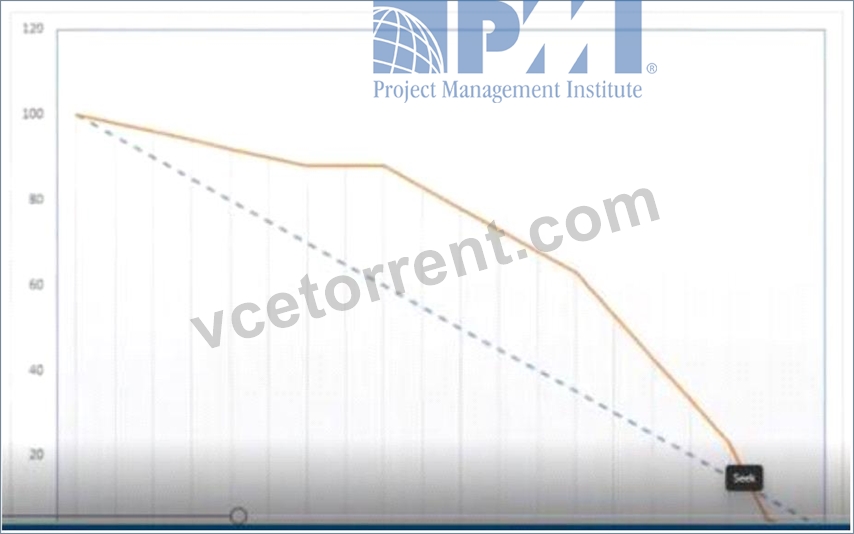
Answer:
Explanation: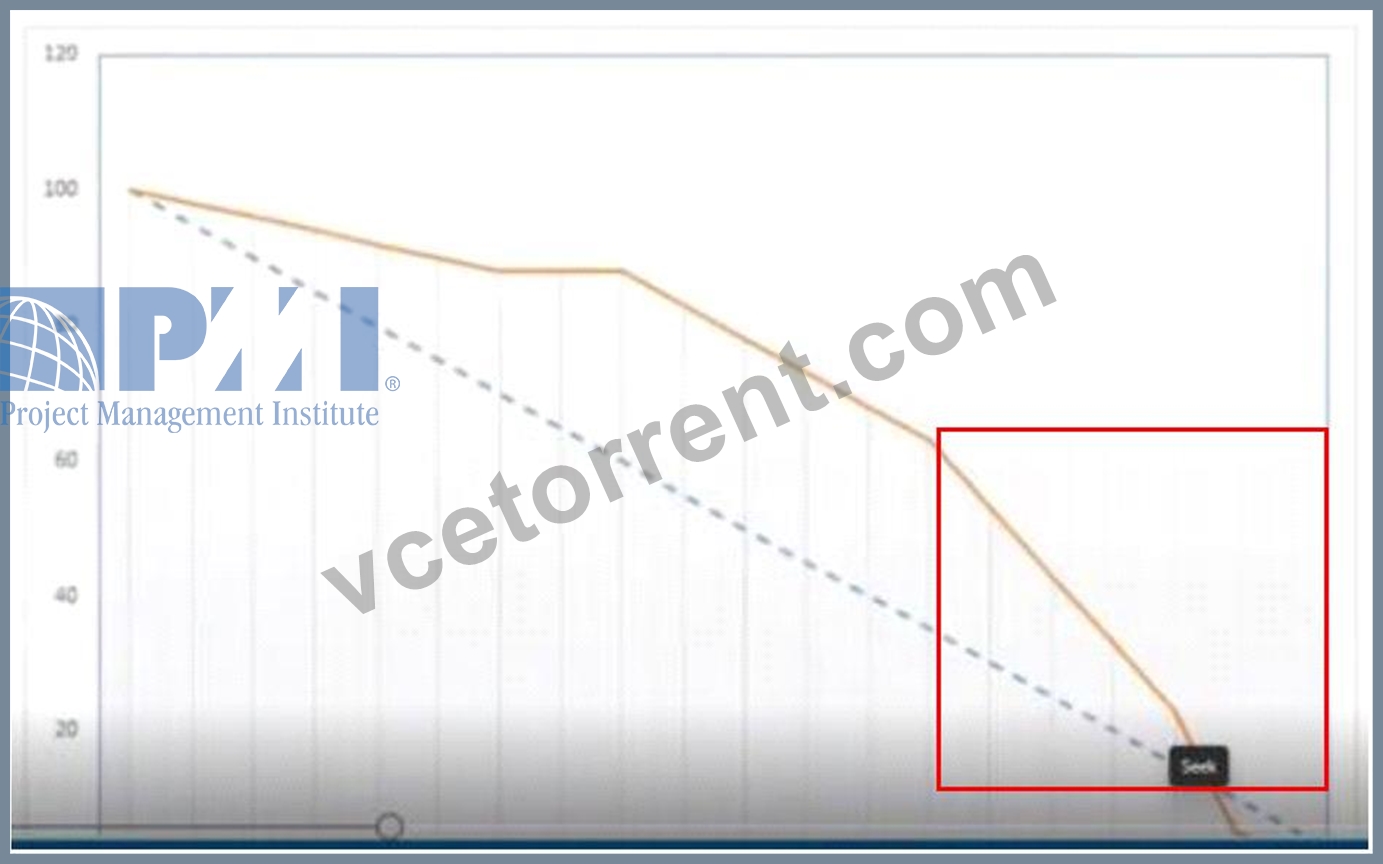
NEW QUESTION # 914
You're managing a software project. Your team has discovered a problem, and as a result you've requested a change. The change will cost the project an extra three weeks, but
without it several stakeholders might have problems with the final product. What's the NEXT thing that you should do?
- A. Document the change and its impact, and put it through the change control system
- B. Instruct the team to make the change
- C. Call a meeting with each stakeholder to figure out whether or not to make the change
- D. Don't make the change because it will delay the project
Answer: A
Explanation:
Every change request needs to be evaluated to determine whether or not it should be made. That's what we do in the Integrated Change Control process - every change is analyzed to determine its impact. It's then documented as a change request and put into the change control system. That's where the stakeholders on the CCB determine if the change should be made.
NEW QUESTION # 915
During the course of a project, a junior team member approaches the project manager for some direction and advice on risk mitigation How should the project manager respond?
- A. Tell the junior team member that the information is available in lessons learned
- B. Offer guidance and follow up with some developmental activity for the junior team member
- C. Refer the junior team member to the senior team member who develops the risk mitigation strategy
- D. Inform the junior team member that risk mitigation is not part of their work
Answer: B
Explanation:
Some of the other options are not appropriate because:
* A. Tell the junior team member that the information is available in lessons learned. This option does not address the immediate need of the junior team member for direction and advice on risk mitigation. Lessons learned are valuable sources of information, but they are usually documented and reviewed at the end of the project or phase3. The project manager should not rely on lessons learned alone to provide guidance to the junior team member, but rather use them as a reference to supplement their own experience and expertise.
* C. Inform the junior team member that risk mitigation is not part of their work. This option is incorrect because risk mitigation is part of the project team's work. PMI states that "The project team is responsible for identifying, analyzing, and responding to project risk."4 The project manager should not exclude the junior team member from the risk management process, but rather involve them and delegate appropriate tasks and responsibilities to them.
* D. Refer the junior team member to the senior team member who develops the risk mitigation strategy.
This option may seem reasonable, but it does not demonstrate the project manager's leadership and coaching skills. The project manager should not pass on the junior team member's request to another team member, but rather take the opportunity to mentor and develop the junior team member. The project manager can consult with the senior team member who develops the risk mitigation strategy, but they should also provide their own guidance and feedback to the junior team member.
I hope this information helps you with your query. However, I suggest that you consult the official PMP and PBA reference materials and guides for more accurate and reliable information. Thank you for using Bing. # References:
1: PMP Exam Strategies for Risk Response: Mitigate Risk, Avoid, or Transfer 2: PMI Talent Triangle 3: Lessons Learned 4: Risk Management Certification | PMI
NEW QUESTION # 916
Product acceptance criteria should be laid down in which document?
- A. Project scope statement
- B. Project scope management plan
- C. Resource assignments
- D. Work breakdown structure
Answer: A
NEW QUESTION # 917
A project manager discovers that the project team is spending a large amount of time delivering several reporting formats for the same project updates to multiple stakeholders. What should the project manager do to reduce the time spent on these activities?
- A. Segment the types of communications to be delivered to different stakeholders.
- B. Update the communications management plan to remove less influential stakeholders.
- C. Delegate all of the stakeholder communications activities to a project team member.
- D. Hold biweekly status meetings to deliver information to all stakeholders at once.
Answer: A
Explanation:
To optimize the time spent on reporting, the project manager should segment the types of communications based on the needs and interests of different stakeholders. This tailored approach ensures that each stakeholder receives information that is relevant to them, without the need for multiple reporting formats for the same updates. It also aligns with the principles of effective communication and stakeholder engagement, which are to provide value and avoid overloading stakeholders with unnecessary information.
: The PMBOKGuide suggests that the format of communication should depend on the type of stakeholder, and various ways should be tailored to each group1. This is further supported by discussions within the PMP community, where segmenting communications is often recommended as a best practice for reducing time spent on reporting to stakeholders2. Additionally, the Professional in Business Analysis (PMI-PBA) materials advocate for the efficient generation of reports that cater to the specific requirements of stakeholders34.
NEW QUESTION # 918
......
Easy Success PMI PMP Exam in First Try: https://examcollection.vcetorrent.com/PMP-valid-vce-torrent.html